
Your Brain Is Better on a Bike — and the Evidence Is Getting Hard to Ignore
By: José Maldonado, Chief Marketing Officer
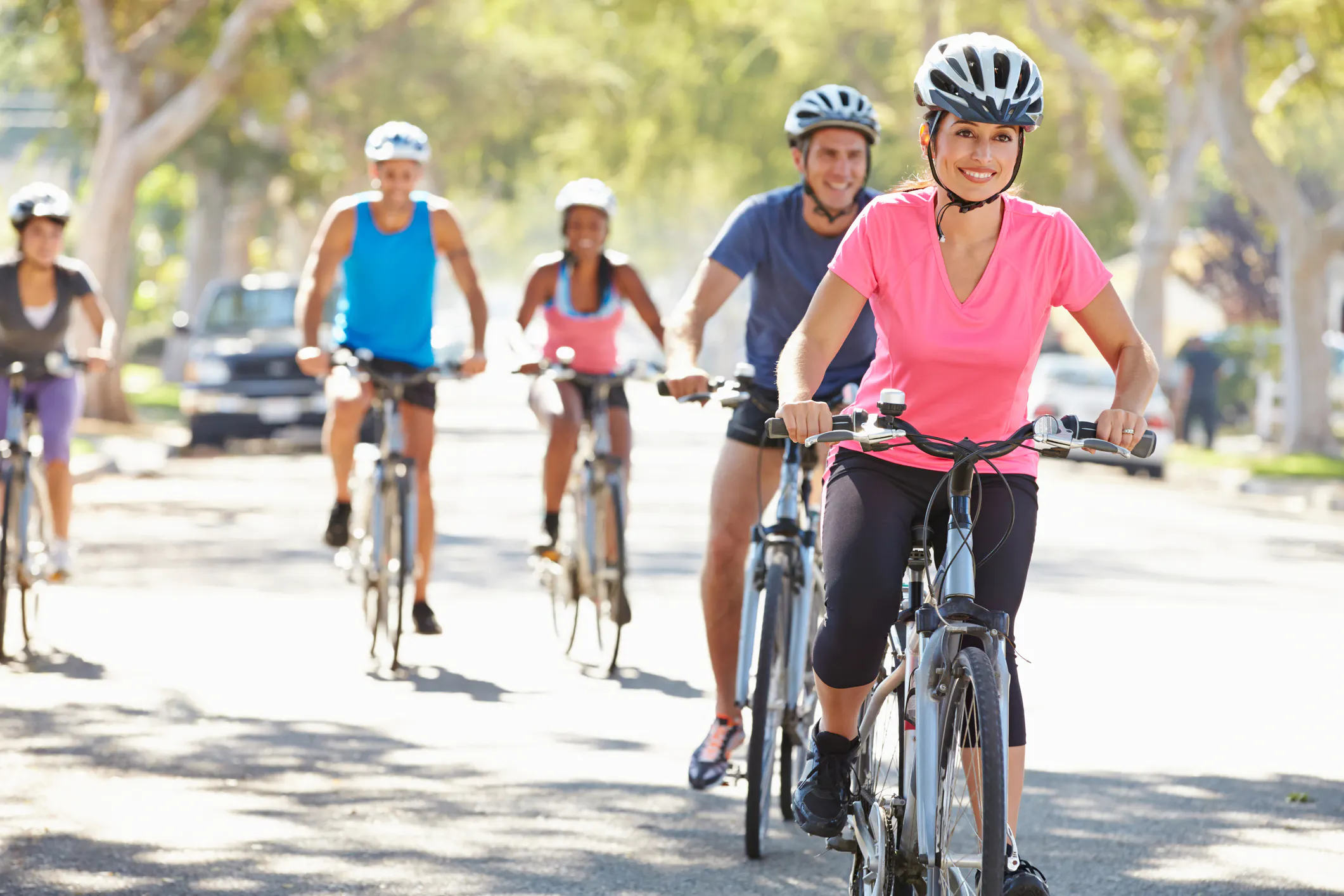
Notes from my first Outride Day.
Outride's reputation is built on Riding for Focus, a six-to-eight-week middle school cycling program running in more than 400 schools across the U.S. and Canada and reaching roughly half a million students each year. The organization’s roots trace back to Mike Sinyard, the founder and chairman of Specialized Bicycle Components, reading a 2012 Bicycling article titled "Riding Is My Ritalin." Recognizing his own undiagnosed ADHD after reading, Sinyard then called the researcher quoted in the piece to ask what it would take to prove the theory. That call then led to the creation of the Specialized Foundation and later, Outride.
What makes the organization stand out is that it funded the science alongside the programming, rather than after it. Working with Dr. Allan Reiss's lab at Stanford, Outride-supported researchers used functional near-infrared spectroscopy, an imaging method worn under a helmet and wired to a pack on the rider's back, to monitor blood flow in adolescents' brains in real time while they rode. The 2019 findings, published in Medicine and Science in Sports and Exercise, showed improved prefrontal cortex oxygenation and cognition in teens with ADHD following riding a bike. A follow-up study found that while riding, the brain activity patterns of teens with ADHD came to resemble those of their peers without it. A 2023 study of more than 1,200 middle schoolers found measurable gains in psychosocial well-being after the program, holding up against established risk factors including gender, socioeconomic status, sleep, and screen time. A review published this spring synthesized 87 studies connecting cycling to attention, reaction time, and cognitive performance.
That's the story I knew going in: a link between bikes, PE class, attention, and behavior, with a real body of literature supporting it.
PeopleForBikes is a proud supporter of Outride, so I arrived already believing in the work. What I didn't expect was how much of the day would be about the other end of the lifespan, or that the two halves would turn out to be the same argument.
The Evidence Has Moved
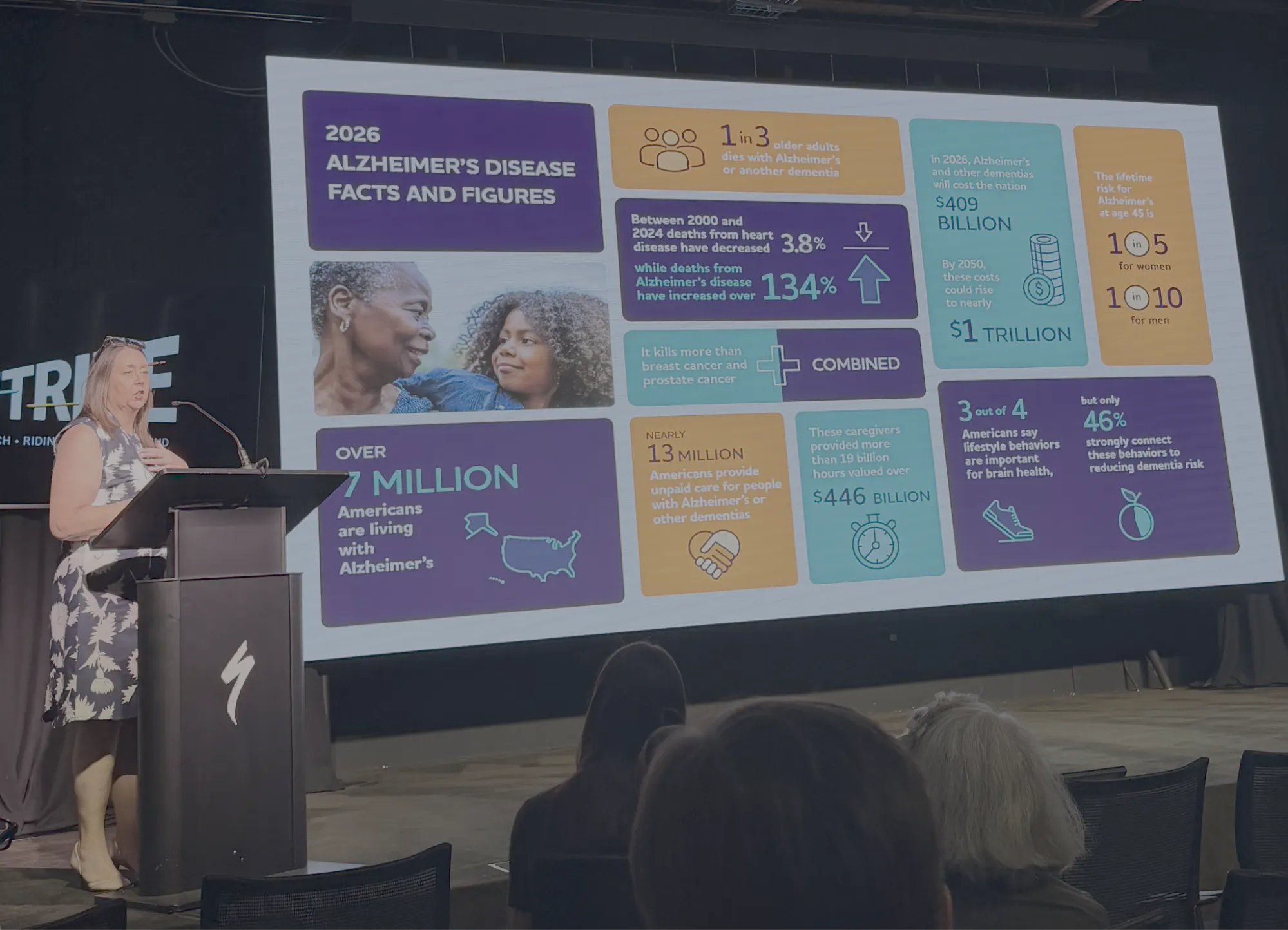
Claire Day of the Alzheimer's Association opened with a line that reframed the whole afternoon: about a quarter of the blood from every heartbeat goes to your brain. We've all heard some version of “What's good for the heart is good for the brain.” Now, the research is catching up to the intuition.
Day then walked through the U.S. POINTER study, a two-year, five-site trial testing whether combining lifestyle interventions, aerobic and resistance exercise, the MIND diet, cognitive training, and cardiovascular risk management produces more benefit than any single factor alone. Participants in the structured intervention showed a statistically significant cognitive advantage over the self-guided group. In practical terms: roughly two years were knocked off the cognitive aging clock.
The part that stuck with me is that the benefit held regardless of age, genotype, ethnicity, or existing cardiovascular risk. Everyone got the upside.
Then, the cycling-specific data. A 13-year study of more than 480,000 participants linked active commuting, cycling prominently among the modes, to a 19% reduction in dementia risk and a 22% reduction in Alzheimer's risk. For younger-onset dementia, the reduction ran as high as 40%.
For an industry that has spent decades making the case that bikes are good for people, this is a different kind of argument. Those aren't vibes, they’re data-driven facts.
The Story Behind the Numbers
Gene Girimonte followed with the personal angle. Girimonte spent years as the primary caregiver for his husband, who was diagnosed with both Alzheimer's and vascular dementia in 2011. Exhaustion, weight gain, high blood pressure, no focus — he described every warning sign of caregiver burnout. Then, he walked into a bike shop with leg braces and a cane, unsure whether he could still ride, and walked out with a bike.
Thirty thousand miles later, he rides 135 miles a week and raises money for the Alzheimer's Association on annual solo tours. Girimonte put it plainly: cycling replaced a sense of helplessness with hopefulness.
"Aging is Just Another Gear"
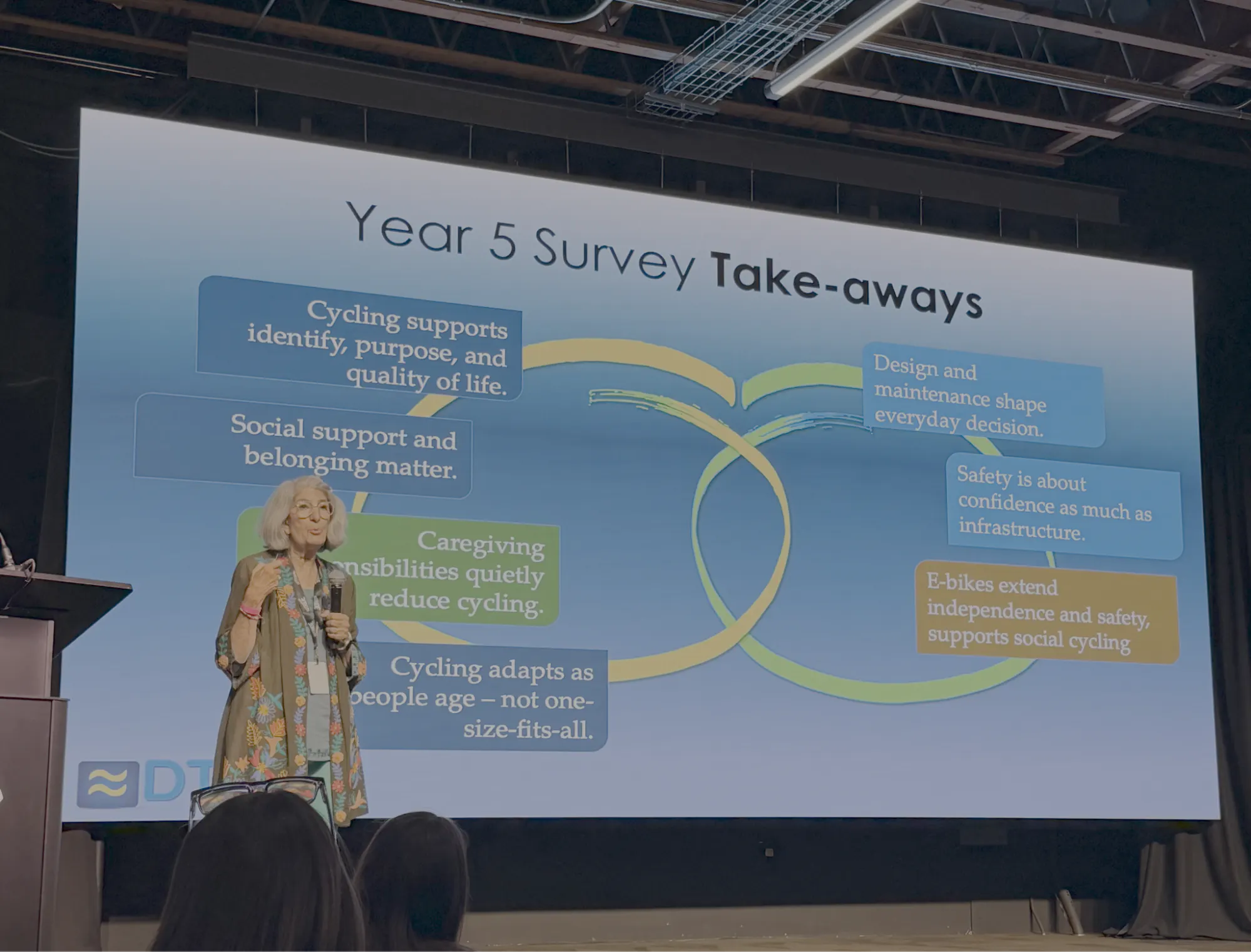
Carol Kachadoorian runs the 50+ Cycling Survey, the result of five years of longitudinal data from riders across the U.S. and Canada, ranging from age 50 to 90+. As far as I can tell, it's the only sustained data set of its kind. A few findings worth calling out:
- Cycling supports identity and purpose, not just fitness. People aren't riding to hit a heart rate zone. They're riding because it's who they are.
- Riding adapts rather than ends. One 76 year old in Kachadoorian’s data is doing 40-mile rides multiple times a week. Another 76 year old decided she's done with 40-mile rides, but is riding differently instead. Both are still riders.
- E-bikes extend the riding timeline. While they’re both an independence tool and a safety tool, a meaningful share of riders still resist them, which is a positioning problem as much as a product one.
- Caregiving quietly erodes ride time. Carol is a caregiver herself. She has less time to ride and has lost her riding partner. It’s not a churn reason anyone captures in a survey field, but it's real.
- Safe places to ride drives everyday decisions. She moved into a new senior living community and won't ride the street out front after two near misses. It took her weeks to find a safe route to the grocery store.
Her sharpest point was aimed at planners and engineers, and I'd extend it to product teams: start designing for the full range of riders, including the 76 year old still doing 40-mile weeks and the one who changed what their riding looks like. Longer signal crossing times. Lower curbs. Better signage at decision points. Design for the riders you actually have.
Dan Burden made the same case by living it. He's 82, rode from Alaska to Argentina in 1972, helped launch Bikecentennial and the TransAmerica Trail, and now leads walking audits and works with Blue Zones on built environments. He rides with electric assist these days in Port Townsend. He also offered the statistic I've repeated three times since hearing it: children today average about ten minutes of outdoor time a day. Prisoners are guaranteed one to two hours.
Where It Actually Starts
Lauren Schuck brought the conversation back to the beginning of the lifespan and the core of Outride's work.
Schuck started with mechanism rather than outcome — what is it about a bike, specifically? Communication, because you're riding in a group of 30 and you need hand signals and awareness of the rider ahead. Resilience — the confidence that comes from the first pedal strokes you ever take. Time in trees and a dose of awe. Social connection, or the opposite — time alone with your own head. All of these characteristics stacking on top of the physical activity, not instead of it.
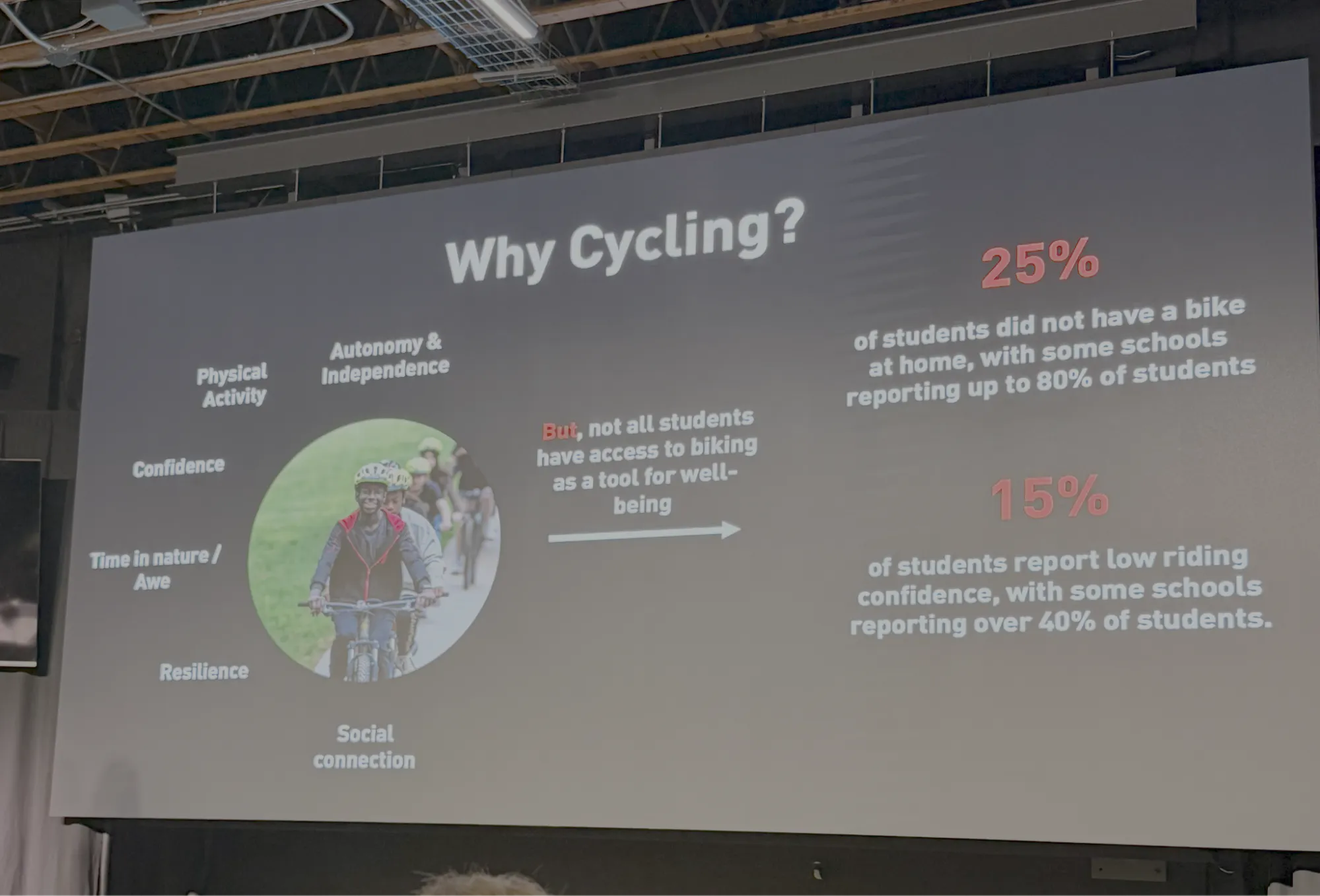
Then comes the access gap, which is where it stops being abstract. One-in-four students entering Outride's programs have no access to a bike at home. At some schools, that number reaches 80%, and it skews higher in urban environments. Fifteen percent arrive with low riding confidence — they either don't know how or don't feel safe trying. And as Schuck pointed out, nobody volunteers for a ride they don't feel confident taking.
Riding for Focus is built to close both gaps at once. Schools apply for a grant and receive a fleet of bikes, helmets, and a six-to-eight-week curriculum that runs inside PE. Pre- and post-surveys track confidence, well-being, screen time, and physical activity.
The results she showed were the most persuasive material of the day.
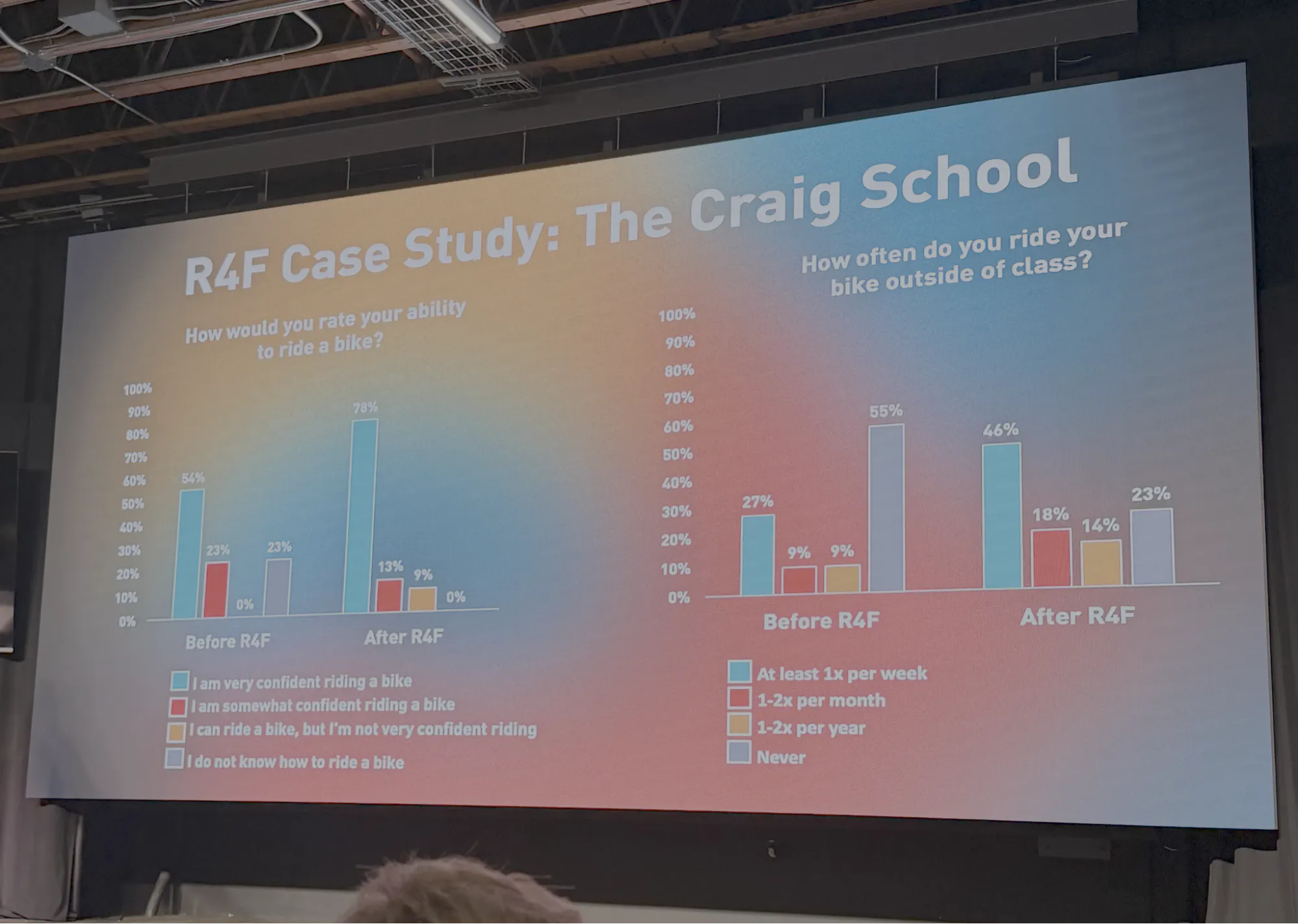
At the Craig School in Southern California, which serves students with ADHD, autism spectrum disorder, and executive function challenges, the share of students reporting they didn't know how to ride a bike went from 23% to zero. Confidence climbed more than twenty points. Riding at least once a week outside of class rose from 27% to 46%, and students who never rode dropped from 55% to 23%. The program didn't just teach a skill — it changed behavior after the bell.
In Wisconsin, teacher Ryan McKinney compared students in a cycling and action sports intervention against a standard enrichment class. The cycling group had markedly fewer office referrals, both minor and major, and showed gains in reading and math. His district was sold. He's been running it for years and now gets kids riding before school.
And across Outride's aggregate school data, there's a clean positive association between how often students ride and their reported well-being. That relationship holds when you control for gender, socioeconomic status — and total physical activity. Something specific is happening with riding that isn't explained by exercise alone.
What It Actually Takes
The closing panel, moderated by Outride's Chazz Robinson, is what I'd want every brand and retailer in this industry to hear. Three practitioners, three completely different operating environments, and a shared answer about what implementation really costs.
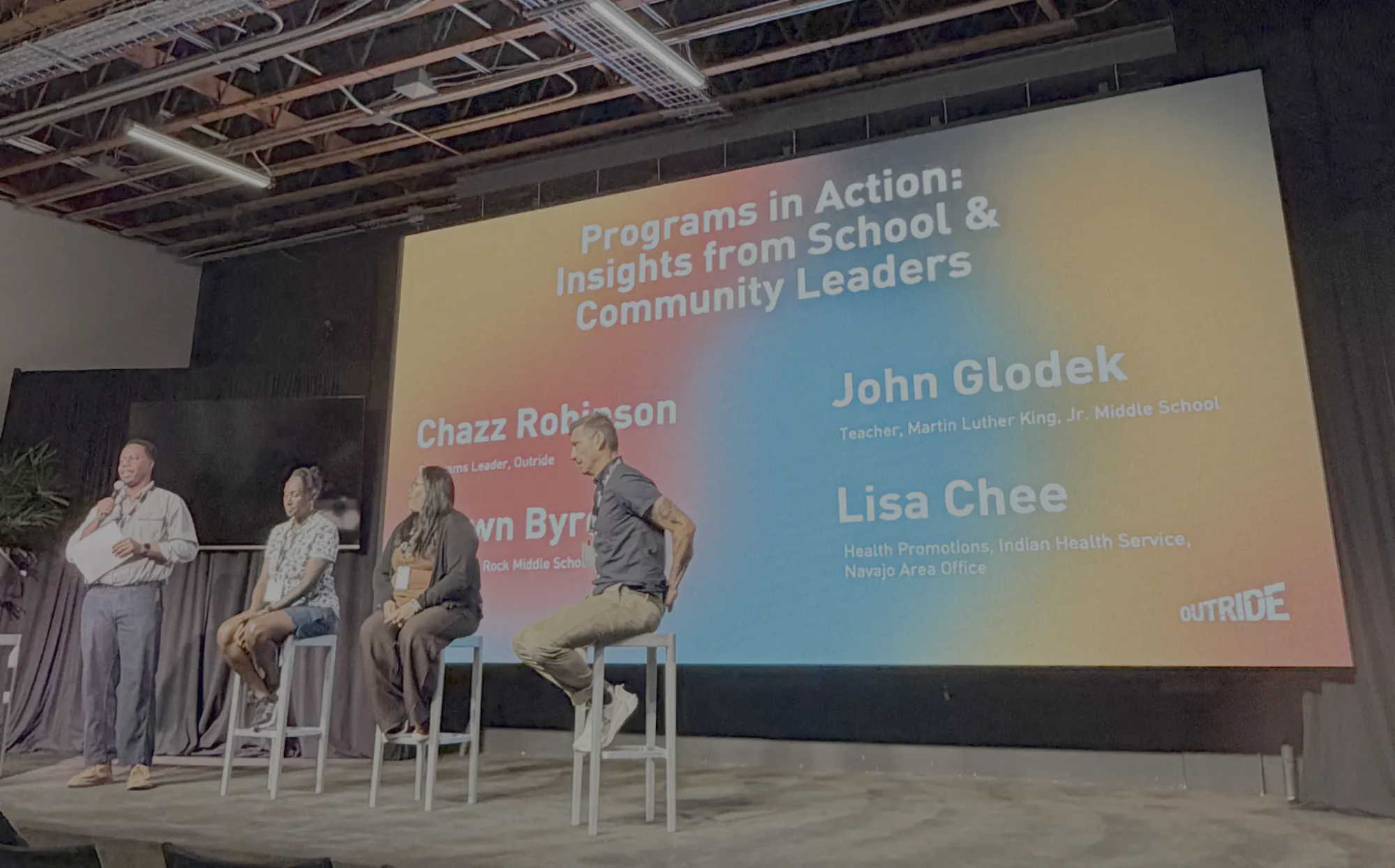
Shawn Byrd teaches PE at Flat Rock Middle School in Winston-Salem, North Carolina and runs the program for roughly 500 students on an A/B day rotation, so every kid rides at least once a week. Five hundred permission slips came back, and then she had to figure out how to teach helmet fit, bike fit, and pre-ride checks to classes of 30+ students. Her solution was to train four or five student leaders per class and have them teach their classmates, with the rule that if their classmates didn't pass, they didn't pass. Students came back to her frustrated. She sent them back to reteach. "That's what teachers do," she said.
Then her district mismanaged $50 million and there was no money to repair bikes. She called a contact in the local bike community, who fixed what he could himself and took the rest to a shop and paid for the repairs out of pocket. Her assessment of the program's impact: the kids are on bikes, so now the teachers want to be on bikes, too. The culture of the school changed.
Lisa Chee works in health promotion and disease prevention for the Indian Health Service in the Navajo Area — a service population of roughly 240,000 people across 27,000 square miles spanning Arizona, Utah, and New Mexico that’s about the size of West Virginia.
She used funds from the Special Diabetes Program for Indians to bring five modular pump tracks to the Navajo Nation. It took two years. Because Navajo Nation land is held in trust, she had to identify lease holders willing to host a track, then coordinate across federal, state, and tribal jurisdictions, each with its own policies. As a federal entity, IHS couldn't move the dirt itself — so land lease holders did the site prep, Outride supported installation, and Silver Stallion sent crews to assemble the tracks. In February, she was driving through snow to meet delivery drivers at roadside and lead them to sites too remote to find.
When the last track went in, kids from an after-school program were waiting on it. One asked how long it would be there. She got to tell him it would be there whenever he wanted to ride.
John Glodek has taught physical and health education for 23 years at Dr. Martin Luther King Jr. Middle School in Germantown, Maryland, and has run Riding for Focus since 2018. His school has close to 900 students. Only four or five ride bikes to school.
His challenge wasn't logistics. It was trust. Taking 32 middle schoolers off campus for a 47-minute period and bringing them back safely isn't something an administrator approves on day one — it took years of practice, lessons, and demonstrated competence. What he's built since has changed the community around the school. Drivers now see a controlled, predictable group of middle schoolers on the road every fall, and they stop to tell him they're glad the program is back.
He also told a story about a sixth grader who spent four days unable to get started and stopping on the bike. Every day, he told her he'd give her one more day. When she finally rode, the entire class stopped and applauded. Her parents emailed him — they hadn't had time to teach her, and school was where she got the chance.
When asked what she wished more people understood, Lisa Chee said she wished people knew how holistically cycling changes a person. John Glodek said he wished more people simply believed in the power of the bicycle for kids growing up right now. Shawn Byrd said her motivation is the students who see her on morning duty and ask whether they're riding today.
What This Means For Us
Four things I'm taking back to the industry:
1. The 50+ rider is a growth segment, not a retention problem. We tend to treat aging riders as leakage from the funnel. The data says they're highly motivated, identity-driven, and willing to adapt — if the product, the fit, the service model, and the route network let them.
2. Brain health is a policy argument. We already make the economic, and safety cases for infrastructure. Dementia risk reduction reaches audiences our usual framing doesn't, and as the population ages, that argument only gets stronger.
3. Access is the constraint, not interest. One in four kids without a bike at home is a market fact as much as an access fact. The Craig School data shows what happens when you remove the barrier: kids don't just learn to ride, they keep riding on their own time. Riding for Focus goes open access by the end of the year, which lowers the cost of entry for any community that wants to run it.
4. The programs run on our industry's back, often informally. A bike shop volunteer paying for repairs because a school district went broke. Specialized supplying equipment. Silver Stallion sending crews into remote communities. Mechanics being trained because there are suddenly more bikes to keep running. That ecosystem is currently held together by individual goodwill. It could be held together by strategy.
We've spent a long time in this industry saying bikes make life better. We're now at the point where we can say how, by how much, and for whom, from a sixth grader in Germantown who'd never been taught to ride, to a caregiver in Sonoma County who wasn't sure he still could.
PeopleForBikes is a proud supporter of Outride. Outride's Riding for Focus curriculum is slated to be fully accessible to the public for free by the end of the year. The Alzheimer's Association's lifestyle tools from the U.S. POINTER study are available through its Rethink Your Brain resource.

Take Action

Donate Now
Bring Better Biking to Your Community