
Traffic Gardens: Turning Empty Spaces Into Places Where Kids Learn to Ride
By: Ray Keener, Contributing Writer
Communities nationwide are converting unused pavement into kid-sized street networks that teach bike skills before kids ever hit the road.
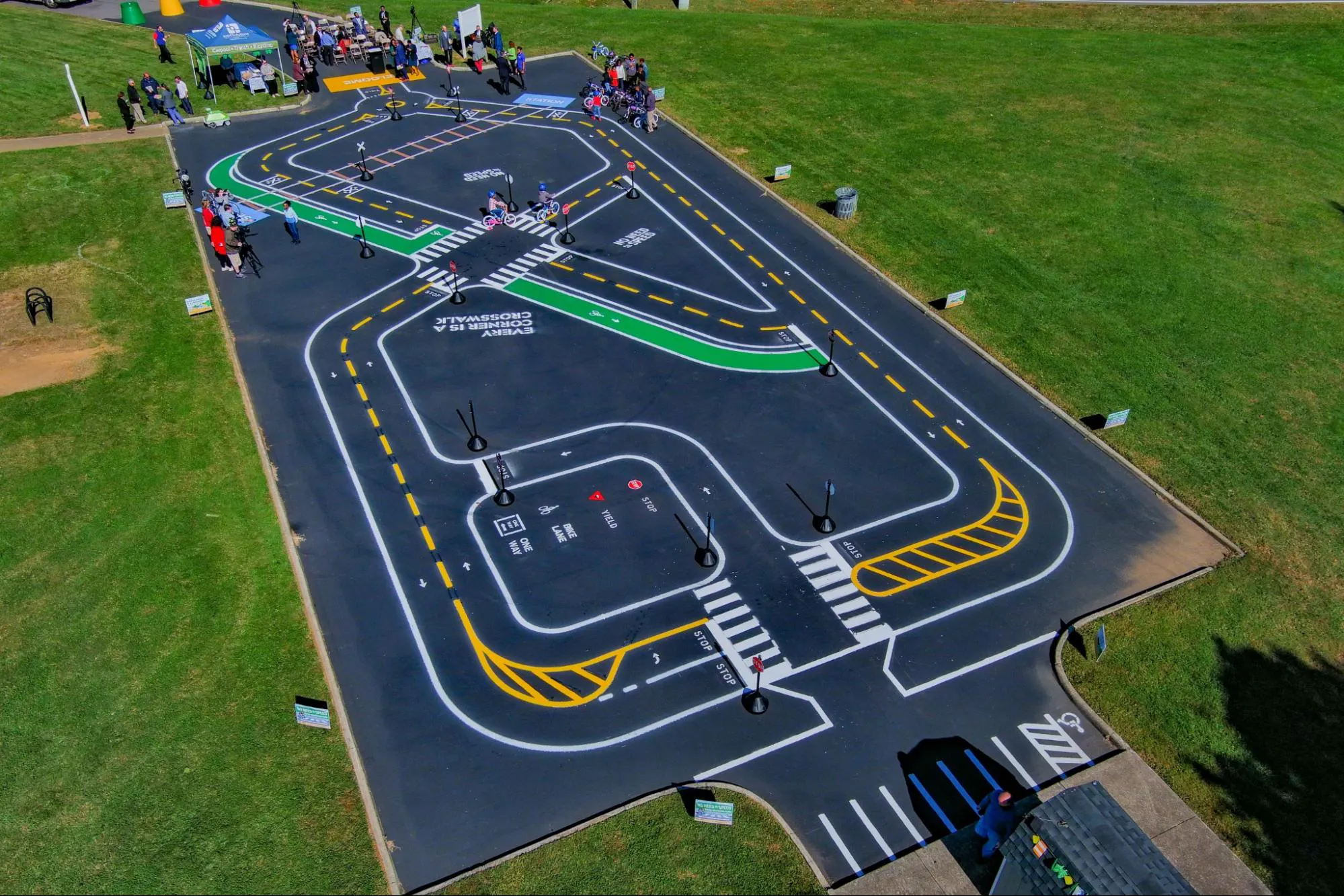
This 50 by 120 foot Traffic Garden in Roanoke, Virginia, is a typical example of a well-executed facility.
Every community has them — an empty parking lot behind a school, an unused basketball court, a forgotten corner of a park.
What if those spaces became some of the most valuable and safest places for kids to ride a bike in your community?
Across the country, schools and local governments are transforming underutilized pavement into traffic gardens: kid-sized street networks complete with intersections, crosswalks, bike lanes, and traffic signs. More than colorful paint on asphalt, these spaces give young riders a safe place to build the confidence and decision-making skills they'll need before venturing onto local neighborhood streets.
Unlike a traditional playground, a traffic garden teaches mobility. It gives children the opportunity to practice stopping at intersections, communicating with other riders, yielding to pedestrians, and navigating everyday situations they'll encounter as they grow into more independent riders.
The traffic garden itself is only the beginning. Schools, educators, and community organizations can build programming around the facilities, using them for bike rodeos, physical education classes, Safe Routes to School events, and learn-to-ride clinics. Together, the traffic gardens and programming form something much more valuable than a painted parking lot. They create a place where kids can safely develop skills they'll use for the rest of their lives.
To better understand why traffic gardens are gaining momentum across the country, we spoke with Fionnuala Quinn, president of Traffic Garden Designs. Over the past eight years, Quinn has helped communities transform more than 40 underutilized spaces into vibrant places where children can learn, play, and experience the joy of riding a bike.
Quinn fell into designing and building traffic gardens after earning a degree in civil engineering and working in wastewater engineering. “In the early 2000s, when I realized that you could actually work as an engineer on bicycle and pedestrian projects, I retooled so that I could join that nascent field,” Quinn says. “Raising kids in the suburbs, I could see a lot that needed improving for people on foot and bike, so that is where I chose to direct my passion.”
Although there had been a long history of scaled-down street networks for children’s bike and pedestrian skills education in the U.S. dating back to the 1930s, they had mostly faded after the 1980s. “In 2010, the idea reemerged in the U.S. as ‘traffic gardens,’ influenced by a Federal Highway Administration (FHWA) report highlighting a Swiss example,” Quinn says. “This was the first federal use of the traffic garden term and it inspired renewed interest and adoption of the concept, especially among transportation professionals and bike-pedestrian advocates.”
Quinn believes that the real opportunity to introduce biking skills is with the youngest riders. “They learn the fastest with the most basic equipment and can be taught readily in groups. They are the future of biking and right now they often receive the least attention,” she says. “We need to focus directly on them and how they get access to a bike, how they learn basic skills, and where they can practice safely. Some places like Washington, D.C. and Seattle are doing that already and the results are tremendous.”
To find out more about implementing traffic gardens at the local level, we also spoke to Rick Holt, founder of Early Childhood Mobility Coalition, who has partnered with Quinn on seven traffic garden projects in the D.C. area. He is also a Licensed Cycling Instructor for the League of American Bicyclists.
Holt posed the key question to ensure a traffic garden’s successful implementation. “If you're going to introduce traffic gardens and bike education in schools at an earlier age, how are you going to support that effort so the community helps the PE teacher to expand their reach, whether the PE teachers are already thoroughly involved in bike education or just getting started?”
“So many districts are dealing with declining enrollments and budget deficits," Holt says. “The great thing about traffic gardens is you don’t need to reinvent the wheel. There’s plenty of information and guidance available online. We recently got a garden started in Dayton, Kentucky. The locals raised $25,000, and now there are four more gardens in Cincinnati across the river. The idea snowballs once people see how well it works to engage kids.”
Alta Planning and Design, based in Portland, Oregon, specializes in sustainable planning, design, engineering, and implementation of active transportation facilities and systems, with 20 years of experience doing bike safety education in schools.
“We did our first implementation in 2021,” says Hannah Day-Kapell, Alta’s director of planning. “Finnouala Quinn engaged with Oregon Metro to provide funding and logistical support, and Alta was brought in to do the final design and installation. We also did an exploratory study for Massachusetts DOT to help them think through what it would look like for them to have a program.”
“We've done the design, the site prep and the actual installation, putting paint on the pavement,” says Day-Kapell on Alta's role in implementing a traffic garden. “We’ve enjoyed engaging with students to help us design the look and feel and think through what kinds of features they want to have in their traffic garden art.”
When asked about the cost to install a typical traffic garden, Day-Kapell had a predictable answer. “It depends,” she says. “It can take a lot of work just to find the right site. If you have a site and you're just doing the design and the install, it can be in the $10,000–15,000 range. If you have to pour a pad or lay down asphalt, double that.”
Alta is focused on measuring the impact of the traffic gardens they develop in partnership with Quinn and others. “First, you need to survey your PE teachers,” Day-Kapell notes. “Are you sure they really want to do this? And how do you measure whether it's actually having an impact where a PE teacher could spend X hours doing something else with the kids? It's really important to see the PE teachers as partners in this, but if they find it a burden, they aren't going to want to do it.”
Finally, we reached out to a physical education professional to get their perspective. Lori Dunn is the pre-K-12 physical education and health literacy program manager in the Seattle Public School system. SPS has a plan to install traffic gardens at every elementary and middle school. Thirty-three schools will be completed before the start of the 2026-2027 school year. The remaining 38 schools are scheduled for completion by 2029 to serve the 20,000 students at elementary grade levels.
Many of the functions in the development and execution of the SBS’s “Let’s Go” bike programming are contracted for with the Cascade Bicycle Club, whose 9,500 members are enthusiastic participants. “We don’t have a district budget for that,” Dunn says. “We have 33 speeding ticket cameras in front of our schools, and revenues generated through tickets is how we compensate Cascade’s people.”
Seattle public school teachers have a lot of leeway in how they spend their class time. “There's no adopted curriculum in the district. Teachers do what they know,” Dunn says. “Most districts don't have a board-adopted curriculum. The question is, ‘What do you want kids to know and be able to do?’ Now figure out a way to fit this into what you're already doing.”
“We have nine fleets of bikes, owned by Cascade, at the elementary level right now. Every school gets three weeks of our ‘Let's Go’ biking unit,” Dunn says. “Our teachers get three hours of foundational professional development, which is taught by myself and Cascade members. The district is hearing great things from teachers, students and parents, so we were glad to hear, ‘How would you like to expand this to the middle schools?’”
At this point, traffic gardens have become much more widely recognized and organized. The term now appears in state programs, policy language, design guidance, and school and parks initiatives across the country.
Quinn was surprised by how hard it has been to get her work taken seriously. “The idea resonates now, but in the early days it took a lot of effort to demonstrate it, and keep it moving forward,” she says. “Meanwhile, I was working with kids and watching them respond very strongly, but it was getting the adults to pay attention and recognize the impacts that was the biggest challenge.”
“One of the most important traits behind my work has simply been not giving up,” she concluded. “There were plenty of difficult moments and even a few hard years where things didn’t go as planned, but I always had a clear sense of what this could become and I stuck with it.”
All kids deserve the opportunity to learn to pedal safely. Are you a bike educator looking to get a traffic garden built in your city? See the results of Quinn’s work at trafficgardens.com, with a broader historical and logistical story at trafficgardensinfo.com.

Take Action

Donate Now
Bring Better Biking to Your Community