
What Other Cities Can Learn From West Hollywood’s Approach to Better Biking
By: Jack Foersterling, Senior Content Manager
A committed city council and connected bike network didn’t happen overnight. Here’s what it took to land on our radar as a 2026 City to Watch.
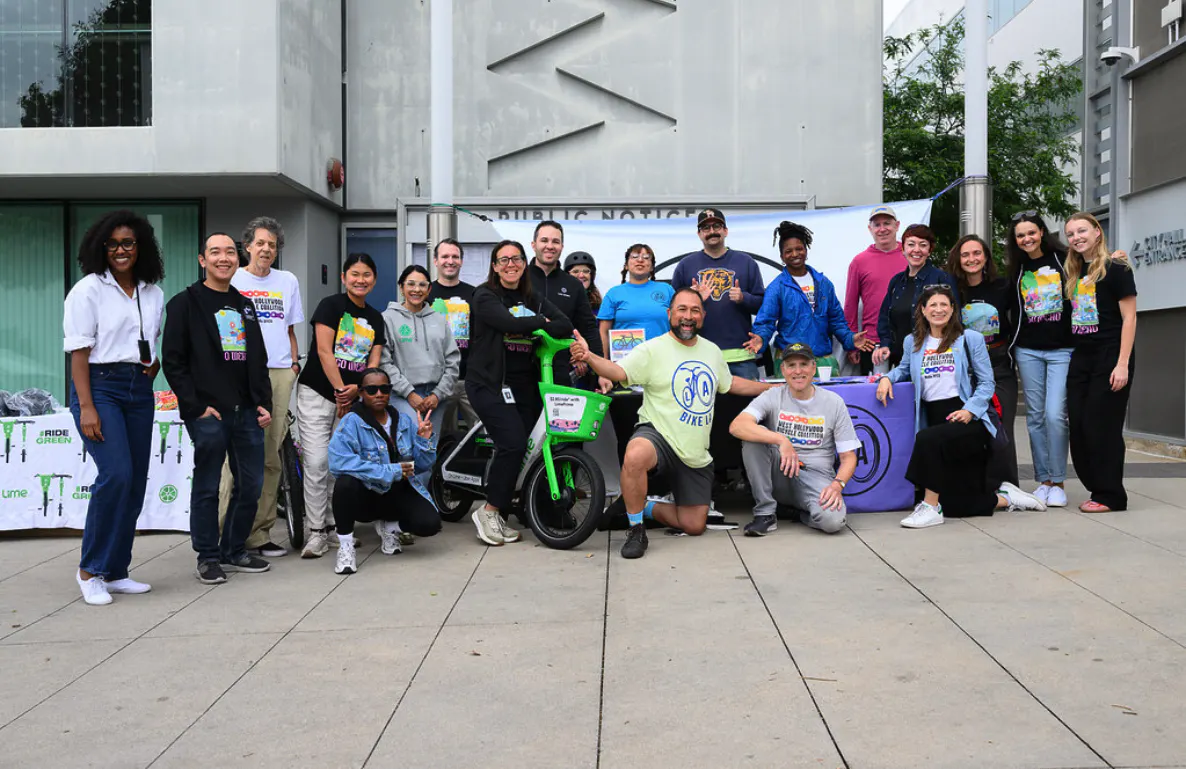
The West Hollywood Bicycle Coalition celebrates Bike Week in collaboration with the City of West Hollywood and BikeLA.
West Hollywood might not be the first place that comes to mind when many people think of great American bike cities. It sits inside one of the most car-dominant metro areas in the world, covers less than 2 square miles, and is surrounded on three sides by Los Angeles — a city which, as Kevin Burton puts it, "is the most challenging urban environment for bicycling I've encountered."
But West Hollywood is changing. In PeopleForBikes' 2026 City Ratings, the city earned a score of 37 out of 100 and a spot on our list of 8 Cities to Watch. Behind that number is a story of persistent local advocacy, an energized city council, and a committed strategy for building a bike network that actually connects people with where they need to go.
Burton is the co-founder of the West Hollywood Bicycle Coalition (WeHoBYCO), a community-based advocacy group that has spent years pushing the city to follow through on plans that were, as Burton describes it, "gathering dust on the shelf." We sat down with him to learn what's working and what other cities can learn from the WeHo model.
A Committed City Council
In April 2025, the West Hollywood City Council unanimously voted to build only protected bike infrastructure on future street projects, making it the first city in the Los Angeles area to make that commitment.
The policy includes a "where feasible" qualifier — protected lanes require an extra 3 to 5 feet of street width minimum, making them impossible on some narrower roads — but Burton is clear that the council's intent is to build protected lanes wherever it can.
"The council is very supportive of doing protected bike lanes where at all possible," Burton says. "But it's not an absolute mandate."
Getting to that vote took years of coalition work: attending city meetings, leading rides with council members, stopping to point out existing and planned lanes, and explaining the safety case for protection — not just for riders, but also for drivers, who cross paths with cyclists less frequently when lanes are physically separated.
Building a Network, Not Just Lanes
One of West Hollywood's most important strategic choices has been to think beyond its own city limits. Surrounded by Los Angeles on three sides and Beverly Hills on the fourth, the city has designed its bike infrastructure specifically to connect with neighboring networks.
"It's a very important consideration for us to build out a network, not only within West Hollywood, but connecting to our neighboring cities," Burton says. "We point this out whenever we're advocating for new bike lanes."
That philosophy is showing up in project design. A new protected lane connecting WeHo with Beverly Hills is being designed to match the green lane treatment already in place on the Beverly Hills side. Plus, virtually every existing and planned WeHo bike lane connects to a corresponding lane in Los Angeles.
This is foundational to how we think about bike networks at PeopleForBikes: a great lane that ends at a city boundary isn't nearly as useful as one that takes you where you need to go. West Hollywood gets that.
What's Coming: Greenways, Road Diets, and the Olympics
West Hollywood has a pipeline of projects that will define how its City Ratings score moves over the next few years.
The Fountain Avenue Streetscape Project is the most ambitious. The city approved a road diet on Fountain Avenue that reduces travel from two lanes to one in each direction to make room for protected bike lanes, wider sidewalks, and new landscaping. Phase 1 construction is anticipated for fall 2026.
The data behind the project is compelling: Of the almost 35,000 cars that travel along Fountain Avenue on a typical day, only 13,000 (36%) have an origin or destination in West Hollywood, meaning a majority of commuters are just passing through The road diet is designed to reclaim that street for the people who actually live there.
A greenway project on a collector street along the city's western edge will install traffic-calming infrastructure — median islands, traffic circles, and diverters — to slow vehicle speeds on a route widely used by cyclists. Critically, all traffic signals on the route will be upgraded to detect bicycles, eliminating the need for riders to dismount to trigger a pedestrian crossing signal. Burton calls that detail essential: "If you want to make it friendly to bicyclists, that matters."
The 2028 LA Olympics is adding urgency to the regional picture. West Hollywood is supporting a dedicated bus and bike lane along one of its major thoroughfares — part of a multi-city route — timed to be completed before the Games. A Beverly Hills connector lane is also in play. With millions of visitors expected and parking already near-impossible in the area, moving people without cars isn't just a policy goal, it's a practical necessity.
Lessons for Local Advocates
Burton has spent years working the levers of local government, and he has actionable advice for advocates trying to move their own city councils in the right direction.
Frame biking as part of a transportation system, not a standalone mode. The argument that resonates, Burton says, is the first- and last-mile problem: most people will never bike exclusively, but millions would bike more if it connected reliably to transit. In Los Angeles, every bus has a rack on the front. Every light rail and subway car allows bikes. Full-size commuter rail even has dedicated bike storage cars. "The thinking should be broader than just bicycling," Burton says. "It's transportation."
Show up where decisions are made. Before WeHoBYCO existed, there was no organized voice for biking at city meetings. Showing up consistently — commenting on projects, asking questions, building relationships with supportive council members — is what moved the needle. "Before us, there wasn't any organized effort to do that," Burton says.
Engage in elections. Bike-friendly policy requires bike-friendly leaders. WeHoBYCO, as a 501(c)(3), can educate voters about candidates' positions without endorsing them. Other advocacy organizations without that constraint can go further. Either way, Burton’s lesson is clear: "Support candidates who support bicycling and its connection to public transportation."
Take the hassle out of parking. In dense, visitor-heavy cities, a relatable pitch for biking is avoiding the frustrating search for a parking spot. "That's one of the great advantages of bicycling and public transportation: avoiding the continual battle to find parking places," Burton says. It's an argument that lands with drivers just as much as cyclists.
Why West Hollywood Is a City to Watch
With a City Ratings score of 37 out of 100, West Hollywood still has real ground to cover. But the ingredients for sustained improvement are in place: a coalition that shows up, a council majority that's willing to act, a pipeline of concrete projects, and a strategic approach to connectivity that extends beyond city limits.
In a region better known for its freeways than its bike lanes, that kind of steady, systematic progress is exactly what’s going to make a difference for better biking.
Interested in improving biking in your community? Explore the 2026 City Ratings to see how your city scores — and what moves the needle.
Related Locations:
Take Action

Donate Now
Bring Better Biking to Your Community