

2026 City Ratings Methodology Updates: What Is Changing and Why It Matters
By: Grace Stonecipher, Infrastructure Analytics and Research Manager

New census data, refined bike network analyses, and updated design standards are reshaping how cities are scored in 2026.
Every year, PeopleForBikes uses the Bicycle Network Analysis (BNA) to produce our annual City Ratings, a data-driven measure of how well a city’s bike network connects people to the places they want to go. This program helps cities identify gaps in their bike networks, highlights opportunities to improve, and benchmarks progress over time.
Since its inception in 2017, the BNA has undergone multiple iterations, including accounting for speed limit differences (2019) and removing the community survey as the program expanded (2021). These updates have steadily improved the accuracy with which City Ratings reflect real-world bike networks.
For 2026, PeopleForBikes is introducing a new set of methodology changes to the BNA to feature the most up-to-date data, reflect best practices in street design, and incorporate feedback from City Ratings users.
With these updates, some cities may see score changes that reflect the updated methodology rather than recent infrastructure changes. As a result, comparisons between 2025 and 2026 should be interpreted with this updated methodology in mind. By introducing these improvements all at once, we can establish a consistent baseline for City Ratings so that future year-over-year changes can more reliably reflect real progress on the ground.
How City Ratings Are Calculated
City Ratings are calculated based on the low-stress connectivity between where people live and important everyday destinations. These destinations fall into six main categories: People, Opportunity (employment, jobs), Core Services (medical care, grocery stores), Recreation, and Retail. Each census block is scored based on its access to these six categories, and then a population weighted average is taken of all block scores to calculate a community’s overall City Rating. Weighting by population means that the scores of census blocks with a higher number of people are going to have a greater effect on the overall rating.
What Changed in the 2026 City Ratings and How It Affects Your Score
Updated Census Data
City Ratings now incorporates 2020 U.S. Census data, which became available in stages through 2023 and 2024, replacing the 2010 baseline used in prior years. To maintain consistency in year-over-year comparisons, City Ratings relies on stable national datasets, which are then incorporated once complete detailed releases are made public.
This update provides a more current view of where people live, improving how the BNA measures access to people. As a result, the People score and overall weighting better reflect today’s population distribution. For example, if a neighborhood with strong bike infrastructure has grown in population, that increased access is now captured in the score.
The BNA has also been updated to use the latest data from the U.S. Census’s Longitudinal Employer-Household Dynamics Origin-Destination Employment Statistics (LODES), which helps us better understand where jobs are actually located within a city and increase the precision of the City Ratings Opportunity score.
Together, these two changes strengthen how City Ratings measures access to people and jobs — two core components of a well-connected bike network.
Updated Bike Facility Standards Based on NACTO Guidance
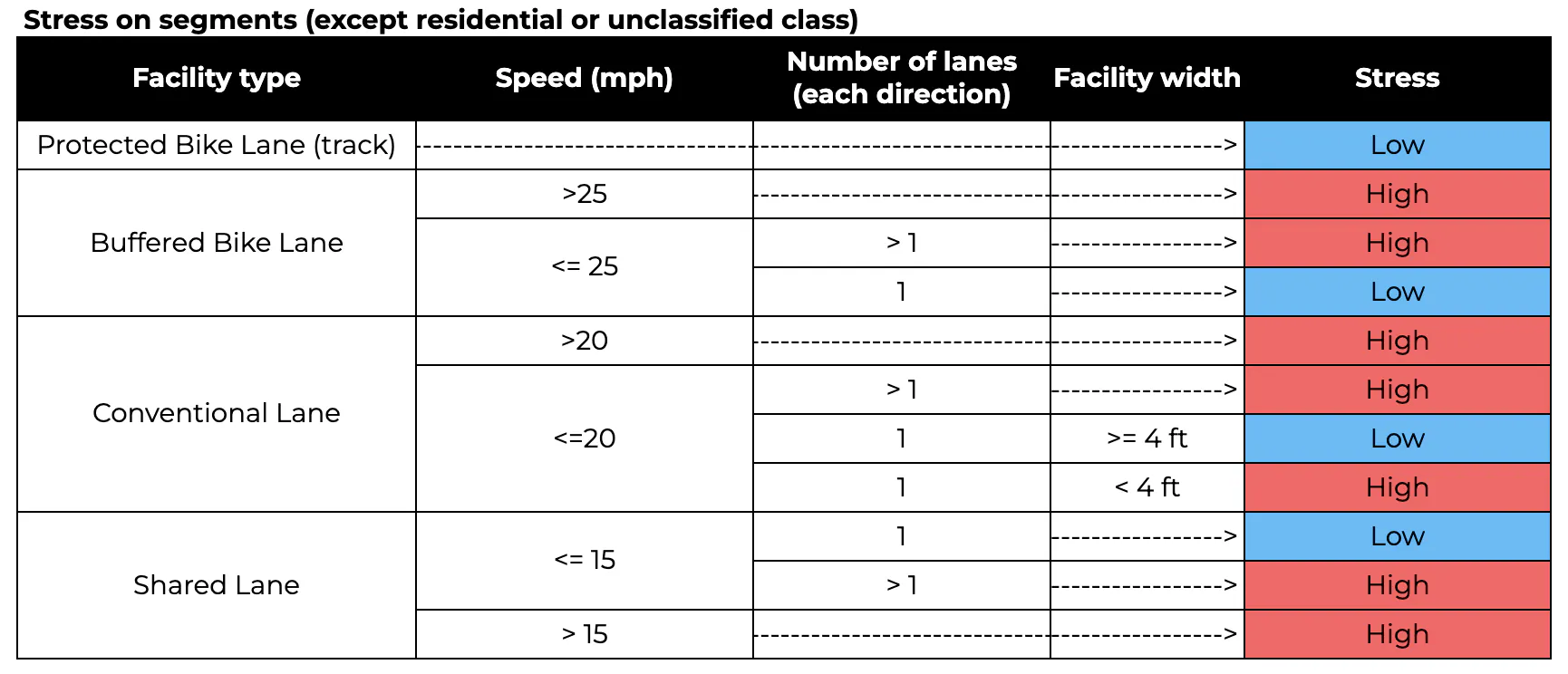
In 2025, the National Association of City Transportation Officials (NACTO) released the third edition of its Urban Bikeway Design Guide. The guide includes updated standards for street design, outlining best practices for building low-stress bike networks for people of all ages and abilities. In accordance with this guide, the criteria for classifying streets as high- or low-stress have been updated in the BNA.
For buffered and conventional bike lanes, lower speed limits are now required for the road to be considered low stress. These updates align City Ratings with current best practices for low-stress bike networks, reflecting how street design standards have evolved in the U.S. over time.
Exclusion of Destinations and Roads Outside City Boundaries
In previous versions of City Ratings, the Bicycle Network Analysis included some roads and destinations just beyond city limits — typically within one to two miles — as part of a city’s score. In some cases, that meant scores were influenced by infrastructure outside a city’s control. Based on feedback from City Ratings users, the 2026 update limits the analysis to roads and destinations within official city boundaries. This ensures each City Ratings score reflects the bike infrastructure and connectivity a city can directly plan, build, and maintain. This change isolates each city’s score to its own network, without influence from nearby areas.
More Direct Bike Routes
The BNA now excludes low-stress routes that require significant detours (more than 25% longer than a direct route), reflecting how people typically choose more direct travel options and avoid biking if long detours are required to do so safely.
Expanded Destination Types
The retail category has been expanded to include all destinations tagged as ‘shop’ in OpenStreetMap. Previously, the BNA only used areas tagged as ‘retail’. However, it has become best practice in OpenStreetMap to tag individual locations as shops, while larger shopping areas with multiple stores are tagged as retail. This update will better reflect the presence of individual retail locations within a city.
Ferry terminals have also been added as a destination in the transit category.
Standardized City Boundaries
U.S. city boundaries are now standardized and fetched directly from the U.S. Census. Previously, boundaries came from multiple sources, including city governments, OpenStreetMap, and the Census.
Exclusion of Inaccessible Areas
In earlier versions of the BNA, some census blocks counted in a city’s score weren’t realistically reachable by bike. These areas weren’t connected to the rest of the network within a reasonable riding distance—often because of physical barriers like water bodies, mountains, or limited crossings. While they may appear close on a map, they aren’t practical to reach by bike. These areas are now excluded from scoring, so City Ratings reflect how well a network works where biking is actually possible, rather than being influenced by geographic constraints outside a city’s control.
More Accurate Classification of Bike Infrastructure
A number of small changes were implemented in the BNA to more accurately classify bike infrastructure. This includes fixes such as no longer classifying golf course paths as cycling infrastructure and updating tags for specific features, such as contraflow bike lanes or two-way protected bike lanes.
The BNA is open source, and all methodology updates are publicly available on the brokenspoke-analyzer GitHub repository.
2026 City Ratings — Coming Soon
These updates mark a meaningful improvement in how City Ratings measures real-world bikeability. By using updated data, aligning with new design standards, and focusing on infrastructure within city control, the BNA now provides a clearer picture of how investments in bike infrastructure are improving connectivity for people riding bikes in communities throughout the U.S.
PeopleForBikes’ 2026 City Ratings will be released in June, highlighting communities that are building connected, low-stress networks — and where critical gaps remain.

Take Action

Donate Now
Bring Better Biking to Your Community