

Why Protected Bike Lanes Are Good for All Road Users
By: Bryan King, contributing writer
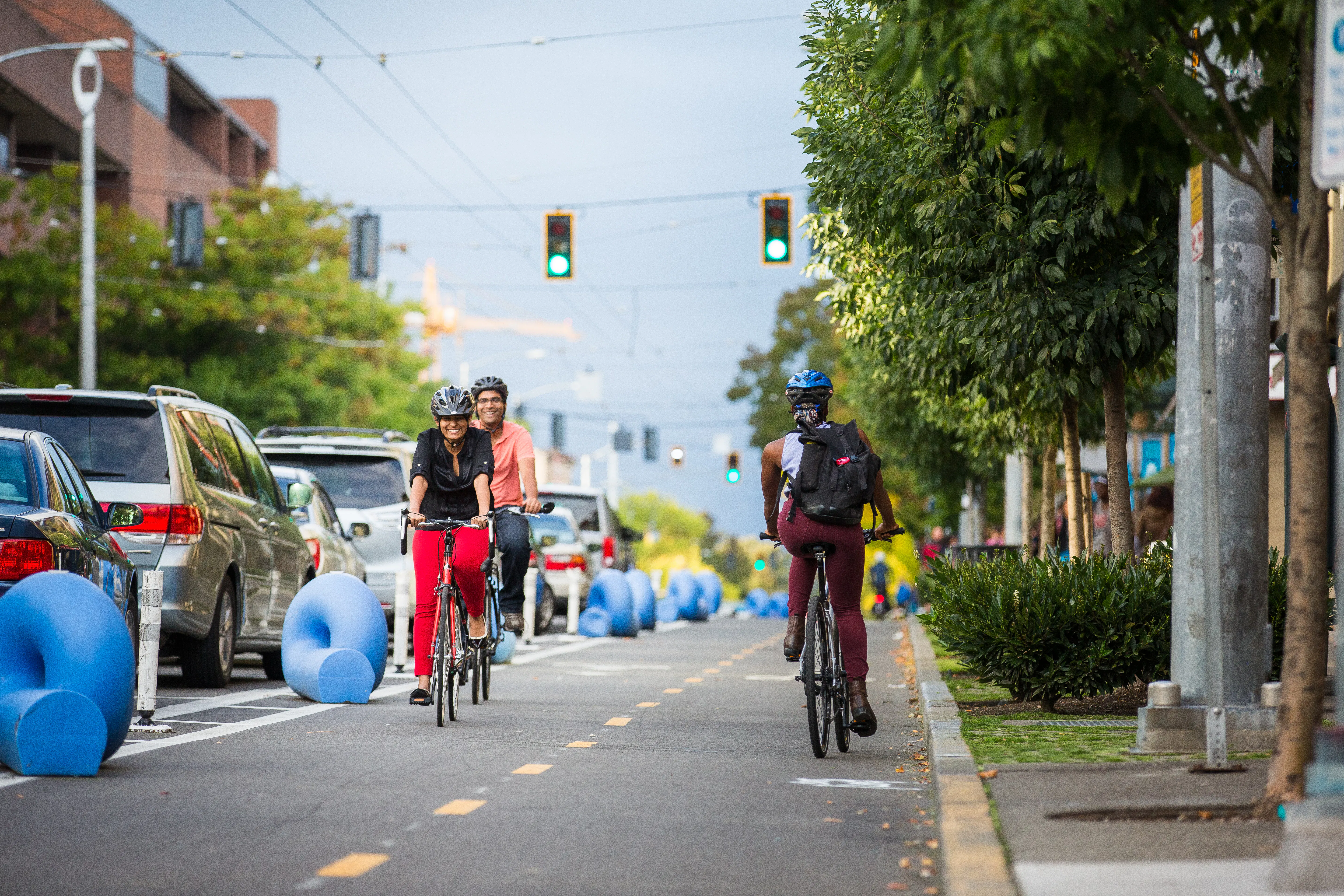
Protected bike lanes don't just keep cyclists safe. Data from cities across the country shows they dramatically reduce injuries and deaths for pedestrians and drivers, too.
When New York City installed protected bike lanes on 9th Avenue, something remarkable happened: injuries for all street users fell by 58%. Across NYC corridors with protected bike lanes, pedestrian injury rates have dropped by 12 to 52% depending on the corridor. These infrastructure improvements aren't just making streets safer for cyclists — they're protecting everyone who uses our roads.
The Mechanics of Safer Streets
Protected bike lanes do more than separate cyclists from cars. They fundamentally reshape how streets function, creating multiple safety benefits for pedestrians as well as people riding bikes. By placing a physical barrier between the bike lane and vehicle traffic, these designs shorten crossing distances at intersections. That means instead of navigating across multiple lanes of mixed traffic, pedestrians cross distinct, predictable zones.
The safety improvements are dramatic. Streets with protected bike lanes in New York City typically see injury crashes drop by 40% for all road users — drivers, pedestrians, and cyclists alike. Some locations have recorded reductions exceeding 50%. A comprehensive study across 12 large U.S. cities found that streets with protected bike lanes had 44% fewer deaths and 50% fewer serious injuries compared to average American streets.
These lanes also reduce turning conflicts at intersections. When cyclists have their own protected space, drivers making turns have clearer sightlines and fewer potential collision points. The result is less traffic weaving, fewer sudden movements, and more predictable street behavior — all factors that directly benefit pedestrian safety.
Cities Leading the Way
Portland, Seattle, and San Francisco demonstrate what's possible when cities commit to protected infrastructure. Portland's fatality rate dropped 75% between 1990 and 2010 as the city built out its protected bike network. Seattle saw a 60.6% decline, while San Francisco recorded a 49.3% reduction in fatal crashes during similar periods of infrastructure investment.
The key to these successes lies in thinking about the broader network. Cities that connect protected bike lanes into comprehensive networks see exponentially better results than those installing isolated segments. Evidence from Austin, Chicago, Portland, San Francisco, and Washington D.C. shows ridership gains of 21 to 171% when protected lanes connect into networks — with proportional safety improvements following.
Philadelphia offers another compelling example. After expanding its protected bike lane network, the city saw a 95% increase in ridership. More cyclists using protected infrastructure means fewer riding on sidewalks — New York City documented sidewalk riding dropping by up to 84% after installing protected lanes, directly enhancing pedestrian safety.
Design Details That Matter
Not all bike lanes deliver equal safety benefits. A 13-year analysis of more than 17,000 fatalities and 77,000 severe injuries across major U.S. cities revealed that only physically separated protected bike lanes improve safety. Painted lanes showed no benefit — and in some cases increased risk compared to unmarked roads. The distinction is crucial: physical separation changes driver behavior and creates genuine protection.
Research from the University of Colorado Denver and University of New Mexico, with findings highlighted by the Insurance Institute for Highway Safety, confirms that cities with more protected bike lane footage per square mile experience fewer fatalities and serious injuries across all road users. However, the study also highlighted that design quality matters. Lanes with frequent driveway crossings, like Washington D.C.'s 15th Street NW, pose higher risks than fully separated or raised designs.
The most effective protected bike lanes use concrete barriers, planters, or parked cars as buffers — not just flexible posts. These robust separations cut cyclist-motorist crashes by 53% while reducing injuries for all street users. Streets with these high-quality protected lanes experience 28% fewer injuries per mile than those without any bike infrastructure.
Addressing Common Concerns
Despite overwhelming evidence, some community members worry that bike lanes make streets more dangerous. The data tells a different story. New York City's comprehensive analysis shows protected lanes reduce total deaths and serious injuries by 18.1%. For pedestrians specifically, these lanes cut deaths and serious injuries by 29.1%, with an even more impressive 39% reduction for seniors.
This safety improvement extends beyond direct infrastructure benefits. Protected bike lanes calm traffic speeds, encourage more predictable driver behavior, and create visual cues that remind all road users to stay alert. They transform chaotic, multi-use spaces into organized corridors where each mode of transportation has its designated place.
An April 2025 analysis of protected bike lane impacts reinforced these findings, directly countering narratives that bike infrastructure endangers streets. As cities expand these networks using federal funding from the Bipartisan Infrastructure Law, we're seeing consistent safety improvements across diverse urban environments.
Moving Forward
For advocates and community members pushing for safer streets, the evidence provides a clear roadmap. Focus on building connected networks rather than isolated lanes. Push for physically separated designs with robust barriers. Use city-specific data in local campaigns — statistics from peer cities can be powerful tools for change.
When engaging with local officials, emphasize that protected bike lanes aren't just cycling infrastructure, they're comprehensive safety improvements that benefit all road users, especially pedestrians. The 44% reduction in deaths and 50% drop in serious injuries across 12 major cities represents thousands of lives saved and injuries prevented.
Protected bike lanes represent one of the most effective tools we have for creating safer streets. The data from cities across the country proves that when we give each mode of transportation its own protected space, everyone benefits — especially our most vulnerable road users.
A.J. Bruning is a personal injury attorney at Bruning Law Firm in St. Louis, Missouri.
Related Locations:

Take Action

Donate Now
Bring Better Biking to Your Community