

Building Better Communities: Paradise Valley’s Transformation From Aging Mall to Bikeable Community
By: Kimberly Huntress Inskeep, contributing writer
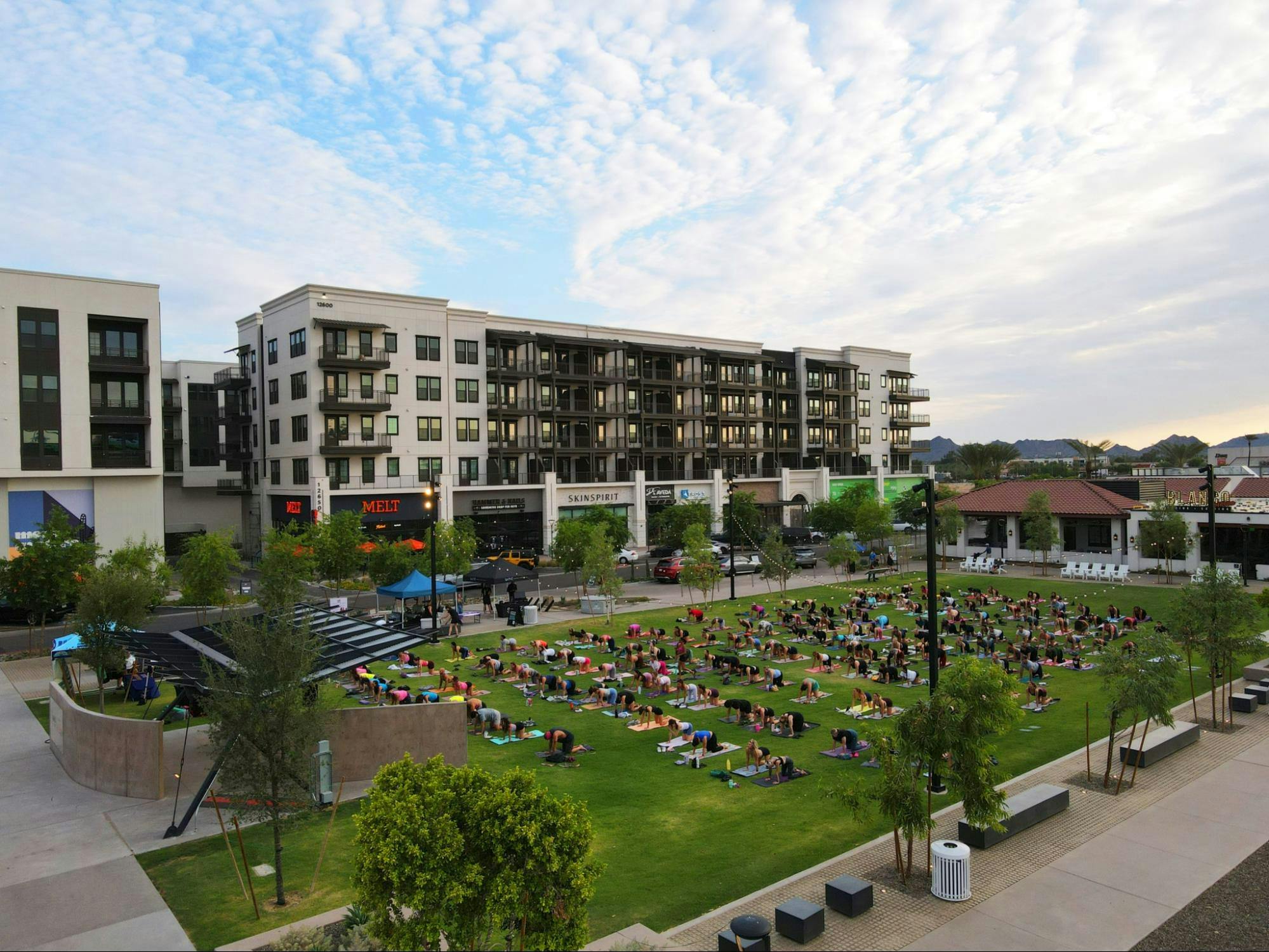
Once a fading, suburban-style mall, PV is now a national model for transforming outdated retail spaces into walkable, bike-friendly, mixed-use communities that prioritize connection and quality of life.
Community members gather in Paradise Valley’s Central Park for Sunday Sweat. Photo courtesy: RED Development
Welcome to PeopleForBikes’ Building Better Communities series, where we highlight the people building great communities across the U.S. — with bikes in mind. Meet the developers building to meet the growing demand for walkable, bikeable neighborhoods, alongside a breakdown of the approaches these visionaries have adopted and their key takeaways on how other communities and developers can build better for bikes and the people who ride them.
Other Building Better Communities Stories:
Like many of its counterparts built in the 1960s and 70s, by the mid-aughts, the 100-acre Paradise Valley Mall in eastern Phoenix experienced a substantial drop in retail activity as shopping habits shifted and tenants moved out. Meanwhile, the mall began attracting substantial community activity — in the form of mallwalking and more. "[Neighbors had] organized all these walking and fitness and stroller groups," says Jeff Moloznik, senior vice president of development at Phoenix-based RED Development. "It went from being a place that people shopped to a place that people used as a community hub."
In 2021, in response to the mall’s long-term decline and the community’s desire for revitalization, Phoenix designated the mall's footprint as an Urban Core for Paradise Valley, one of the city’s 15 villages (not to be confused with the bordering city of Paradise Valley). RED pounced to acquire the property. "That Urban Core designation allows for the kind of density and multimodal transportation we are developing,” Moloznik says. Converting existing commercial properties into more productive uses is a hot topic in real estate in many parts of the U.S.
As part of the redevelopment process, RED carried out extensive community engagement. "A theme we heard over and over and over was how much the community will all miss being able to walk in the mall for a form of exercise and community togetherness," says Moloznik.
To recreate the access and activity the Paradise Valley community had enjoyed, RED planned pedestrian and bike connections as a central part of the site's street network, laying out a grid extending in all four directions with extensive shading from trees to beat the Arizona heat.
Today, most of the mall’s buildings are being demolished and its parking lots repurposed as RED redevelops the site. A walkable, bikeable center is emerging to offer neighbors the togetherness and activity they crave.
The Opportunity: Redeveloping for Active Life and Many Uses
With its promise of integrating residential with retail, the Urban Core designation made for an attractive redevelopment prospect that could retrofit a bikeable, walkable community onto the old mall site. PV — as the site is now known — will offer a similar convenience, community, and quality of life to the suburban village of Paradise Valley, usually reserved for city dwellers.
Biking and walking were key to RED’s planning. First, because the surrounding community had been clear about its desire to have a place for exercise and gathering. Second, because Phoenix’s long-term master plan calls for the extension of the village’s internal network of bike and walk pathways, better connecting to city streets and surrounding neighborhoods. Nearby multi-use paths like the Arizona Canal Path and Cross Cut Canal Path further connect the village to the rest of Phoenix and Maricopa County. Third? Growing e-bike adoption. "There's so much [e-bike] activity that happens all around these residential neighborhoods and to be able to have the feeder connections into ours is something that we see a tremendous amount of value for," Moloznik says. Onsite, covered bike parking, racks accommodating bikes of different shapes and sizes, and repair stands at north and south entrances all send a clear “Welcome” message to bicyclists.
PV will expand in phases over the next several years, but the bike-walk grid is already in place, and Moloznik reports the network is well-used. “We feel like we were able to enhance the opportunity for the community to be active.”
"[Transit also] played a major factor in RED’s early interest and the theme was front and center from the very beginning of our community engagement process,” Moloznik says. Plans for Valley Metro’s light rail include an extension to the village, now slated for launch by the end of the decade thanks to Maricopa County voters, who last fall voted to continue funding for system expansion.
The PV project has attracted area favorites like Flower Child and Wren House Brewing as well as heavy hitting national chains like Whole Foods and Sephora.
The Return on Investment: Fast and Friendly
PV’s first 400 residential units came online in early 2025 as RED continues to add more residential, retail, and office space over the next decade, offering studios, one-, two-, and three-bedroom units. When its residential phases are complete, PV will offer 2,500 units.
Moloznik says RED has been surprised by how quickly PV is being built out and leased across residential, retail, and office uses — a testament to strong demand for walkable, mixed-use living. Residents and visitors now enjoy the kind of lifestyle typically associated with urban centers, where they can easily walk from a coffee shop to lunch and then to happy hour. “It has a stickiness that doesn't happen when you're focused on a single destination."
Moloznik attributes that stickiness to the site's active nature, where customers amble around rather than dashing through. "Our retailers absolutely love it, especially our restaurants, because customers are coming in and spending more time on the property and in their establishments. Restaurant sales are already top of market in the Phoenix area."
Another of RED's newest nearby projects is Biltmore Fashion Park, an open-air mall steeped in Phoenix history. The mall was initially created by the Wrigley family as a shopping experience for guests of their Biltmore Hotel. RED's work on Biltmore Fashion Park involves adding density and enhancing its walkable and bike-friendly elements.
Both the Biltmore and PV are family friendly, with ample open space and year-round programming like outdoor movie nights and fitness events. "We just did a big outdoor painting class for kids and families in our Biltmore project, where we had different stations set up by various different artists and kids could move from one to another throughout it and essentially take an art class," says Moloznik.
"We're definitely out looking at other opportunities to replicate this, because a lot of communities are in a similar situation with the regional mall. RED views the PV and Biltmore Fashion Park projects as evolutions in mixed-use development,” he adds. “Giving a suburban community the opportunity to have an urban core is something that's going to be really sustainable long term... because it does give the surrounding community a sense of place."
Lessons for Developers and Local Governments
Incentivize Flexible Zoning Standards
One boon of building in Phoenix that Moloznik thinks other cities could do well to emulate is its Planned Urban Development (PUD) process, which offers developers the flexibility to write their own zoning standards — so long as those standards exceed the city's existing code. "The entire point of it is to encourage higher quality development in exchange for modifying the existing code standards and requirements. You're rewarded for that by having the additional density that allows you to create more value." RED is permitted to build up to 120 feet in much of the PV site. That flexibility includes setbacks, which Moloznik says is crucial for providing ample room for bicycling and walk pathways.
Share Parking
Another form of flexibility Phoenix’s PUD offers is its shared parking model, allowing RED to include less parking and more revenue-generating features and amenities. The policy recognizes that in a multi-use development "various uses (office, residential, retail, etc.) have different peak parking demand times throughout the day.” For example, when some residents drive to work or errands elsewhere during the day, visitors and retail customers can use what would otherwise be unoccupied spaces.
Coordinate Cross-Departmental Goals and Processes Through Strong Civic Leadership
"You have to work with the streets department, the fire department, the police department, the water services department. [But department] goals aren't necessarily aligned with each other," Moloznik explains. That means one critical element for a development like PV is strong leaders to ensure work is well-coordinated across those many departments.
Value the Investment in Community Engagement
Community engagement is required by Phoenix’s PUD process. The timeline can be long, and took about two years for PV. Moloznik thinks developers should embrace it. “Something that I think goes against the grain of a lot of development is to get in front of the community leaders early and often and even if you don’t know what you’re going to ultimately end up doing.”
Moloznik is emphatic about the value of community engagement — especially if developers do their own research and outreach. “There’s no filter to what you hear when you’re there listening. I think it dispels a lot of the fear that people have in the community when you’re coming in and disrupting what exists. From our experience, the best outcomes for the community and for our properties is when we do that.”
Related Locations:

Take Action

Donate Now
Bring Better Biking to Your Community