

The Best New U.S. Bike Lanes of 2025
By: PeopleForBikes Staff
New bike infrastructure built in cities from coast to coast last year highlights nationwide momentum for transforming our streets and communities into safer, more livable spaces.
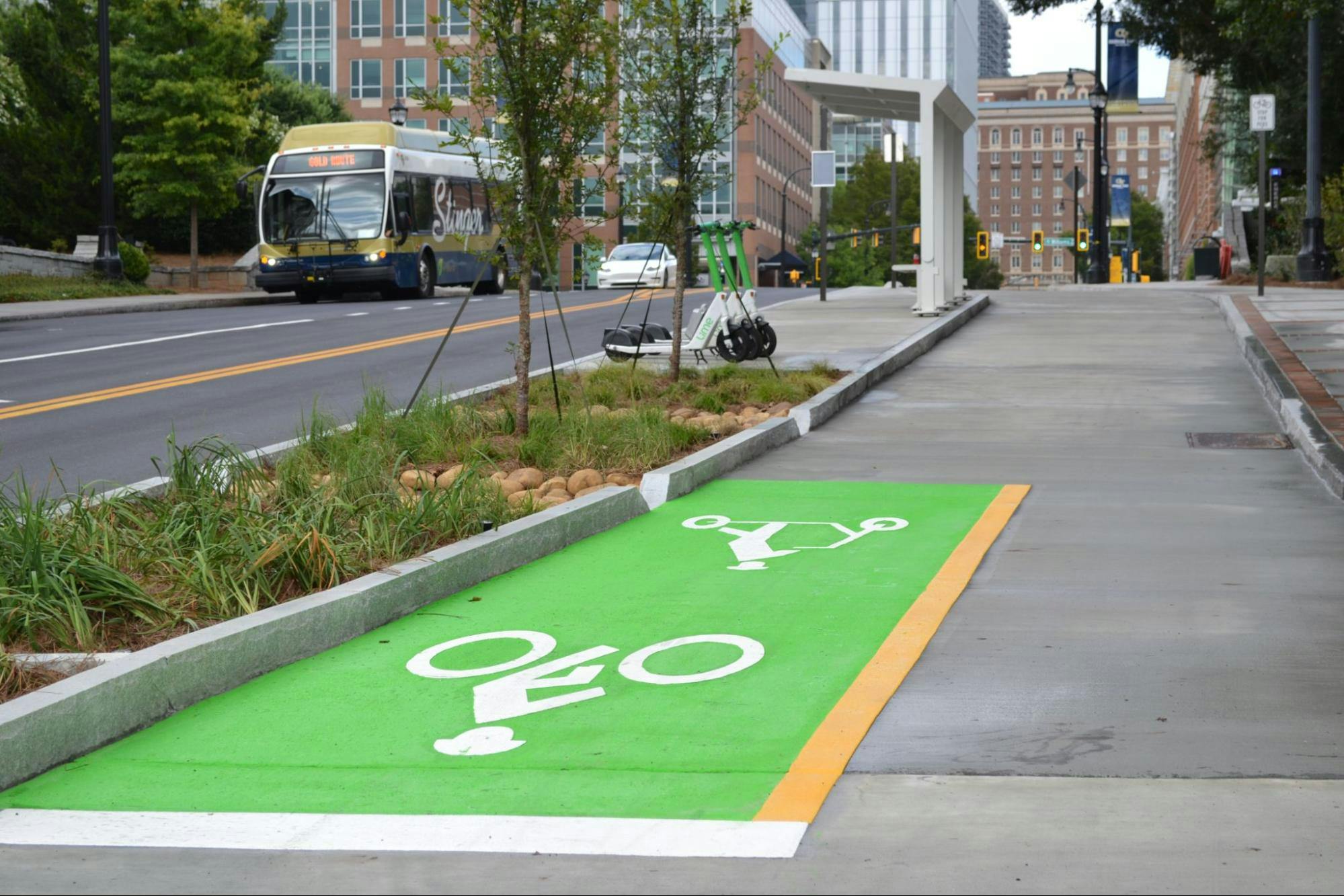
Ferst Drive in Atlanta. Photo courtesy of the Georgia Institute of Technology
2025 was a banner year for better biking as cities across the U.S. moved beyond paint and flex-posts and invested in permanent, people-centered street design. The best bike projects built last year are fully protected, thoughtfully engineered, and tailored to the needs of their communities, making streets safer and easier to navigate for people of all ages and abilities.
These new bike lanes combine physical separation with placemaking, integrating features like public art, landscaping, and transit connections to create vibrant community spaces that benefit everyone, not just those who ride. Together, these projects show how raising the bar for bike infrastructure can strengthen neighborhoods, improve environmental outcomes, and create streets that work better for all members of a community.
Waterfront Bike Lane | Seattle, Washington
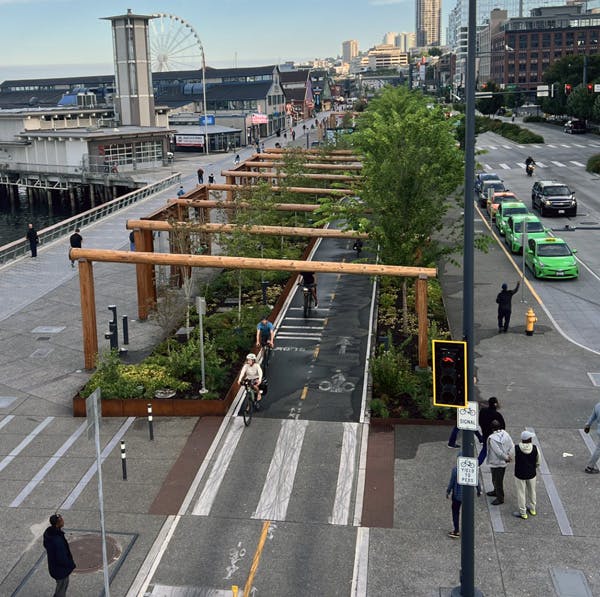
Seattle’s new Waterfront Bike Lane. Photo courtesy of the City of Seattle
Seattle’s new 1.2-mile Waterfront Bike Lane reconnected downtown with Elliott Bay after the removal of the Alaskan Way Viaduct. Built in the space once occupied by the elevated highway, the corridor now features a two-way protected bike lane, a waterfront promenade, seating areas, and plantings. Cyclists can easily connect to routes along 2nd and 4th Avenues, Spring Street, Elliott Way, Yesler Way, Pike and Pine Streets, and Melrose Avenue. A future extension will tie directly into the Elliott Bay Trail.
The bike lane runs through Pioneer Square, with historic brick buildings, and Belltown, known for dense housing, restaurants, nightlife, and the Olympic Sculpture Park. Along the route, a three-block installation by artist Oscar Tuazon — part of Seattle’s 1% for Art program — adds a series of sculptural posts inspired by traditional longhouse architecture with Indigenous carvings at either end.
The project is one of many Seattle has rolled out in recent years, helping propel the Emerald City from a City Ratings score of 42 in 2019 to 66 in 2025, making it the third-highest-scoring large U.S. city after Brooklyn and Minneapolis.
Slauson Rail-to-Rail Active Transportation Corridor | Los Angeles, California
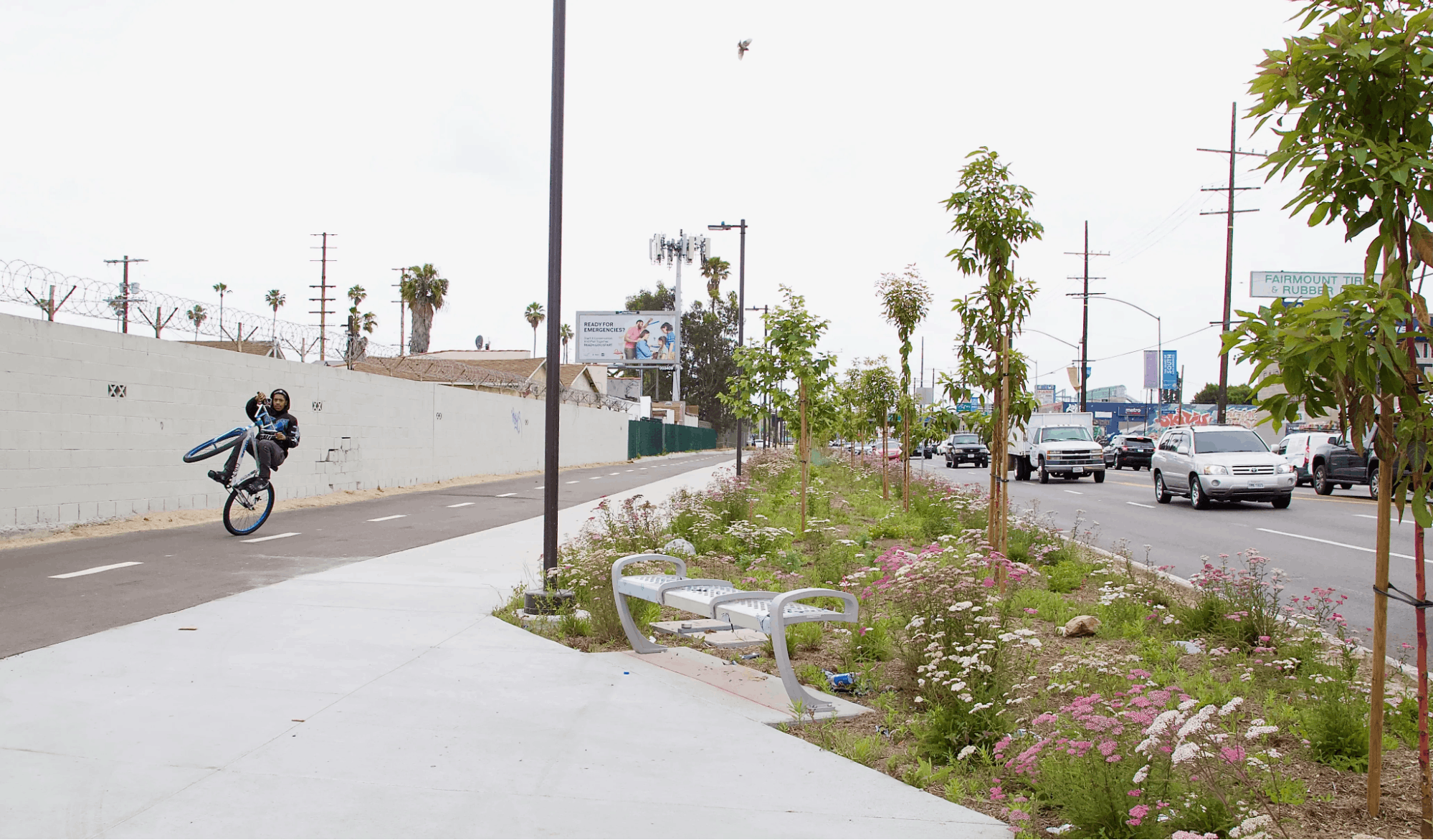
The Slauson segment of the Rail to River project. Photo courtesy of Sahra Sulaiman via Streetsblog LA
As part of the long-planned Rail-to-River project, Los Angeles turned a neglected right-of-way into a shared-use path lined with hundreds of new trees, bioswales, pedestrian-scale lighting, and bike share stations. The completed Slauson segment of the Rail-to-River project (known as Segment A) stretches 5.5 miles from 67th Street and 11th Avenue to Slauson Station on the Metro A Line. The path links schools, transit, parks, and businesses, providing a safe, accessible route for both recreation and commuting in South Central Los Angeles.
As local advocates celebrate the project’s success, they continue to push for completion of Segment B before the 2028 Olympics, which would extend farther east to the LA River and create a vital link in a regional network that will ultimately connect South LA to Long Beach and beyond.
West Midway Avenue | Alameda, California

Alameda’s West Midway Avenue. Photo courtesy of Maurice Ramirez (City of Alameda)
Before West Midway Avenue’s recent redesign, the corridor had no bike facilities, narrow and disconnected sidewalks, and none of the ADA-compliant or green-infrastructure features now common in people-oriented street design. “West Midway went from a wide, empty roadway to a complete street that finally reflects the kind of community Alameda Point is becoming,” said Rochelle Wheeler, senior transportation planner for the City of Alameda. The upgraded corridor now features a raised two-way protected bikeway, continuous ADA-compliant sidewalks, improved intersections, new lighting, and native landscaping supported by bioswales that help manage stormwater and reduce the risk of flooding.
A key part of the redesign was creating a bikeway that feels intuitive and safe for people of all ages. “Raising the bikeway and tightening the intersections sends a clear message: people biking and walking belong here,” said Wheeler. This segment of West Midway connects directly to protected bikeways on Saratoga Street and West Tower Avenue, with additional segments under construction that will extend the corridor east toward Stargell Avenue and into the rest of Alameda.
The surrounding neighborhood — home to new housing projects, supportive housing, offices, a food bank, restaurants, and active redevelopment sites — is also benefiting from significant sustainability improvements. The street’s new bioswales provide stormwater management and environmental protection in an area especially vulnerable to climate impacts. As Wheeler explains, “For a low-lying island already feeling the impacts of sea level rise, these bioswales aren’t just nice to have — they’re essential infrastructure.”
Kinsley Avenue | Providence, Rhode Island
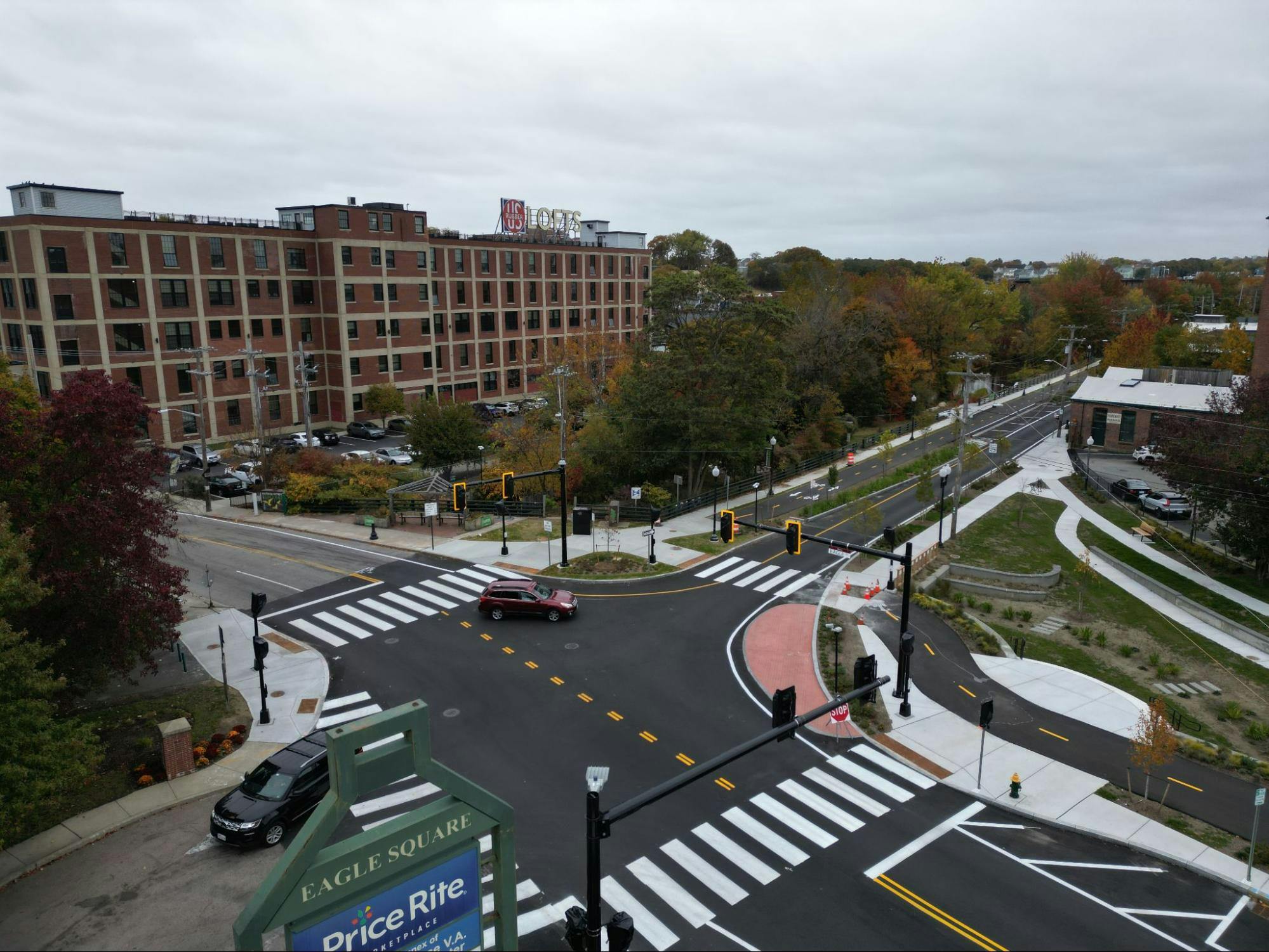
The Woonasquatucket River Greenway Improvement Project added a one-mile, shared-use path along Kinsley Avenue, connecting Downtown Providence to nearby Olneyville, closing a missing link in the seven-mile Woonasquatucket River Greenway. The project, which was championed by former Providence Mayor Jorge Elorza and led by the City of Providence in coordination with the Woonasquatucket River Watershed Council, added a grade-separated cycle track, traffic calming, an accessible canoe and kayak launch, mini-parks, and nature-based stormwater systems adjacent to the existing river.
These upgrades boost both mobility and recreational opportunities while supporting the neighborhood’s ongoing evolution. In recent years, the Valley area has transitioned from a primarily industrial district to a vibrant mix of industry, restaurants, artist studios, nonprofits, and residential spaces.
“This project is about access. Access to safe transportation, to the river itself, to green space, and to opportunity,” said Alicia Lehrer, executive director of the Woonasquatucket River Watershed Council. “The moment it opened, people were there. Now, every time I go by, I see others walking, biking, pushing strollers, and stopping to look at the river. It has changed how people use this place.”
Hennepin Avenue | Minneapolis, Minnesota
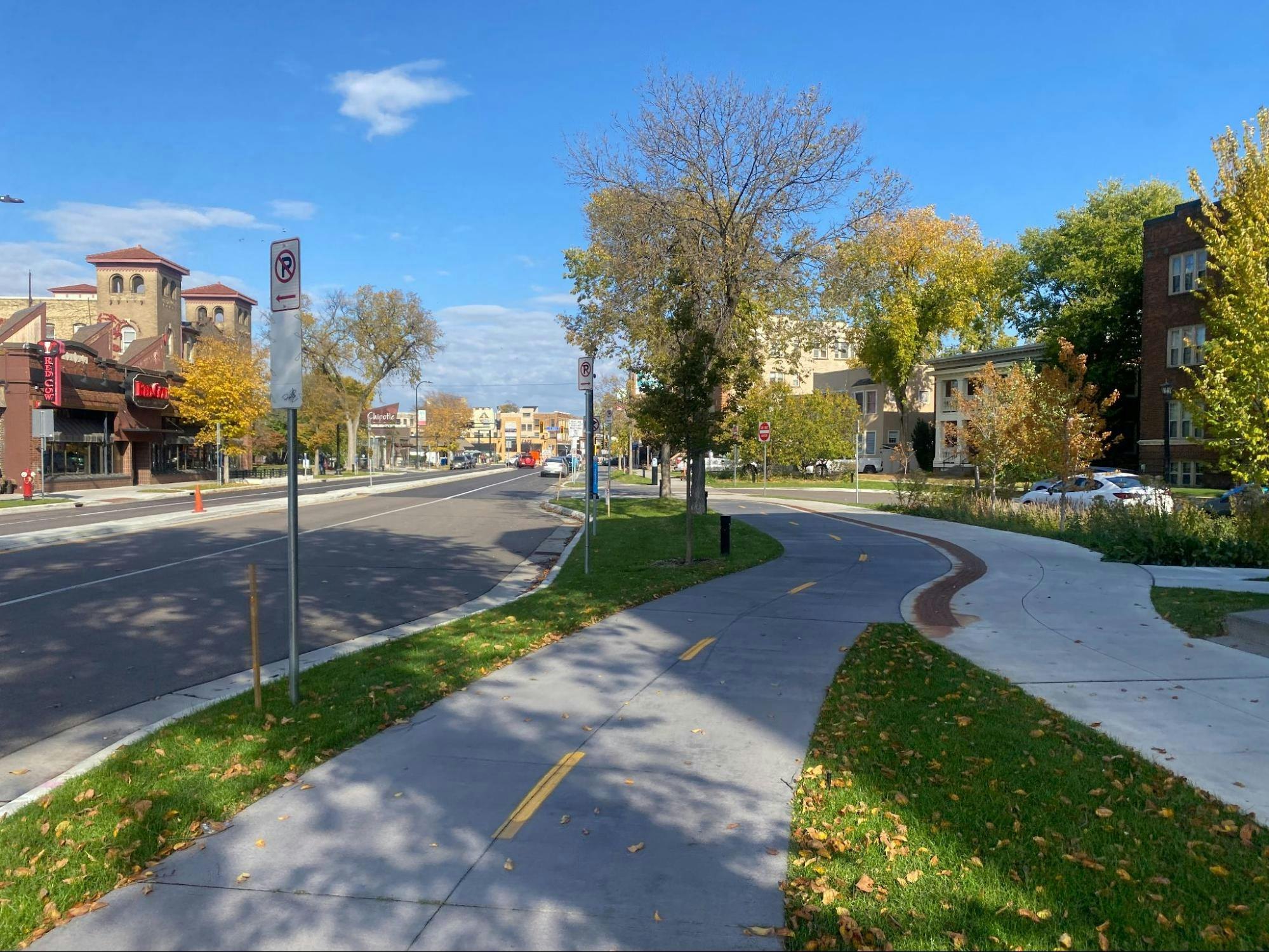
Minneapolis’ Hennepin Avenue cycle track. Photo courtesy of Alex Schieferdecker
Minneapolis, ranked as the second-best large U.S. city for biking in PeopleForBikes’ 2025 City Ratings, recently completed a $36.7 million overhaul of Hennepin Avenue South from West Lake Street to Douglas Avenue, adding curb-level protected bike lanes, wider sidewalks, raised medians, traffic calming, upgraded transit infrastructure, decorative lighting, and green stormwater systems.
“Our goal was to balance the needs of all users while supporting the neighborhood and local businesses,” said Alex Schieferdecker, pedestrian and bicycle coordinator for the City of Minneapolis. The new two-way bikeway connects downtown, Uptown, Lake Street, and Bde Maka Ska, linking to the Loring Greenway, Midtown Greenway, and other nearby bike routes. “The City of Minneapolis has begun designing almost all new bikeways as curb-level or on-street curb-protected,” Schieferdecker added. By the end of 2025, the city will have nearly 19 miles of curb-level bikeways and more than nine miles of on-street curb-protected routes.
Wilson Street Corridor | Madison, Wisconsin
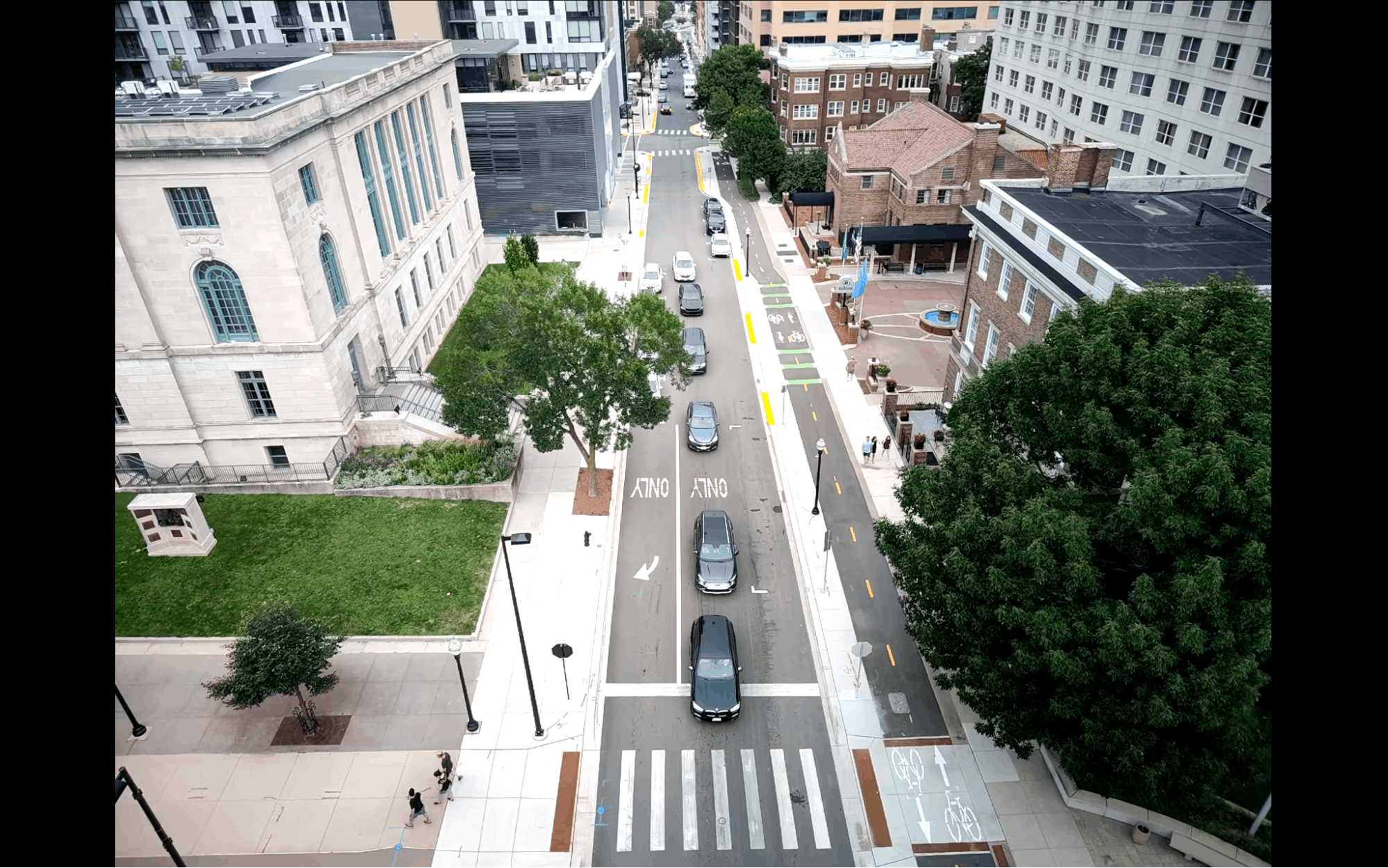
Madison’s Wilson Street cycle track. Photo courtesy of the City of Madison
Madison’s Wilson Street redesign added a two-way, curb-level cycle track linking the Capital City Trail and Southwest Path. Structural soil was also added as part of the project to help new street trees thrive.
“Wilson Street was largely without any bike facilities, requiring bikes to occupy a vehicle travel lane on a street with vehicle speeds and volumes that exceeded what is considered comfortable for an all-ages shared street,” said Aaron Canton, an engineer with the City of Madison. “The two-way Wilson Street cycle track creates a safe link between the Capital City Trail and the Southwest Path, providing an alternative to crossing Highway 151 and giving people a far more comfortable way to reach downtown.”
South Main Street | Columbia, South Carolina
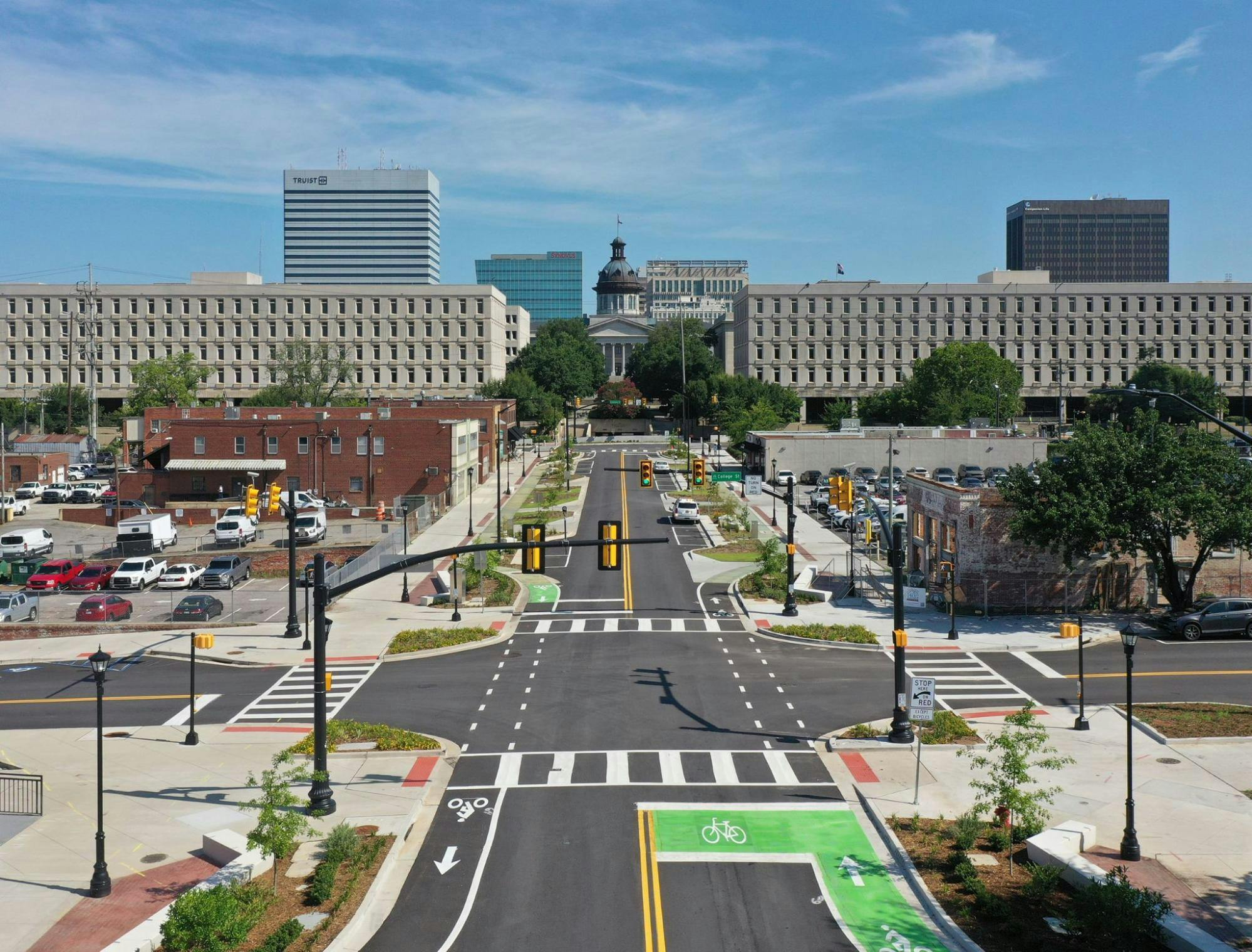
Columbia’s South Main Street bike lanes. Photo courtesy of SCDOT
Columbia’s first sidewalk-level protected bike lanes on South Main Street link the Statehouse to the University of South Carolina. The project converted a busy five-lane road into a calmer two-lane street, featuring raised bike lanes, wider sidewalks, shorter crosswalks, and enhanced landscaping for a safer, more inviting experience.
“We realized this was the right place to build the city’s first cycle track because of its visibility and high pedestrian activity,” said Lucinda Statler, the city’s planning administrator. “This corridor carries some of the highest pedestrian counts in the state, especially during class changes,” added Joshua Meetze, program manager at the South Carolina Department of Transportation (SCDOT). “Reducing the roadway width and providing a protected bike facility significantly improved safety and comfort for people walking and biking.” The redesign also relocated overhead utilities underground, enhancing both safety and the visual character of this civic gateway.
Early feedback has been overwhelmingly positive, and the corridor now strengthens key north-south and east-west bike connections in downtown. As Statler put it, the project has become “a separated facility that people are excited about and want to see more of.”
Ferst Drive | Atlanta, Georgia
Ferst Drive. Photo courtesy of the Georgia Institute of Technology
Georgia Tech’s new bidirectional cycle track on Ferst Drive links Tech Square and Marietta Street with the 5th Street Complete Streets project in Midtown. The cycle track replaced a narrow, unprotected bike lane with a curb-separated path, floating bus stops, and simplified, safer convergences for all users.
“[Before construction], bus stops all crossed over the bike lane, resulting in dangerous conflicts between bikes, scooters, and buses,” said Jason Gregory, a landscape architect at Georgia Tech. The redesigned corridor now includes floating bus stops, in-lane bus boarding areas, permanent curb separation, and simplified intersections.
The project also highlights how academic research can spark real change on the ground. In 2018, a team of Georgia Tech students studied safety options for Ferst Drive, comparing separated bike lanes to a cycle track. Their findings were later confirmed by traffic engineers and eventually landed on the desk of the City of Atlanta, helping move the concept from classroom analysis to a real transportation project. “The students’ work showed the cycle track reduced conflicts across the entire corridor,” Gregory said.
Today, the Ferst Drive project is a hub in a growing network for bikes, e-bikes, scooters, and skateboards across Georgia Tech’s campus, connecting Georgia Tech to the Midtown Core, a future BeltLine Spur link, and planned routes to Centennial Olympic Park.
Summer Street | Somerville, Massachusetts
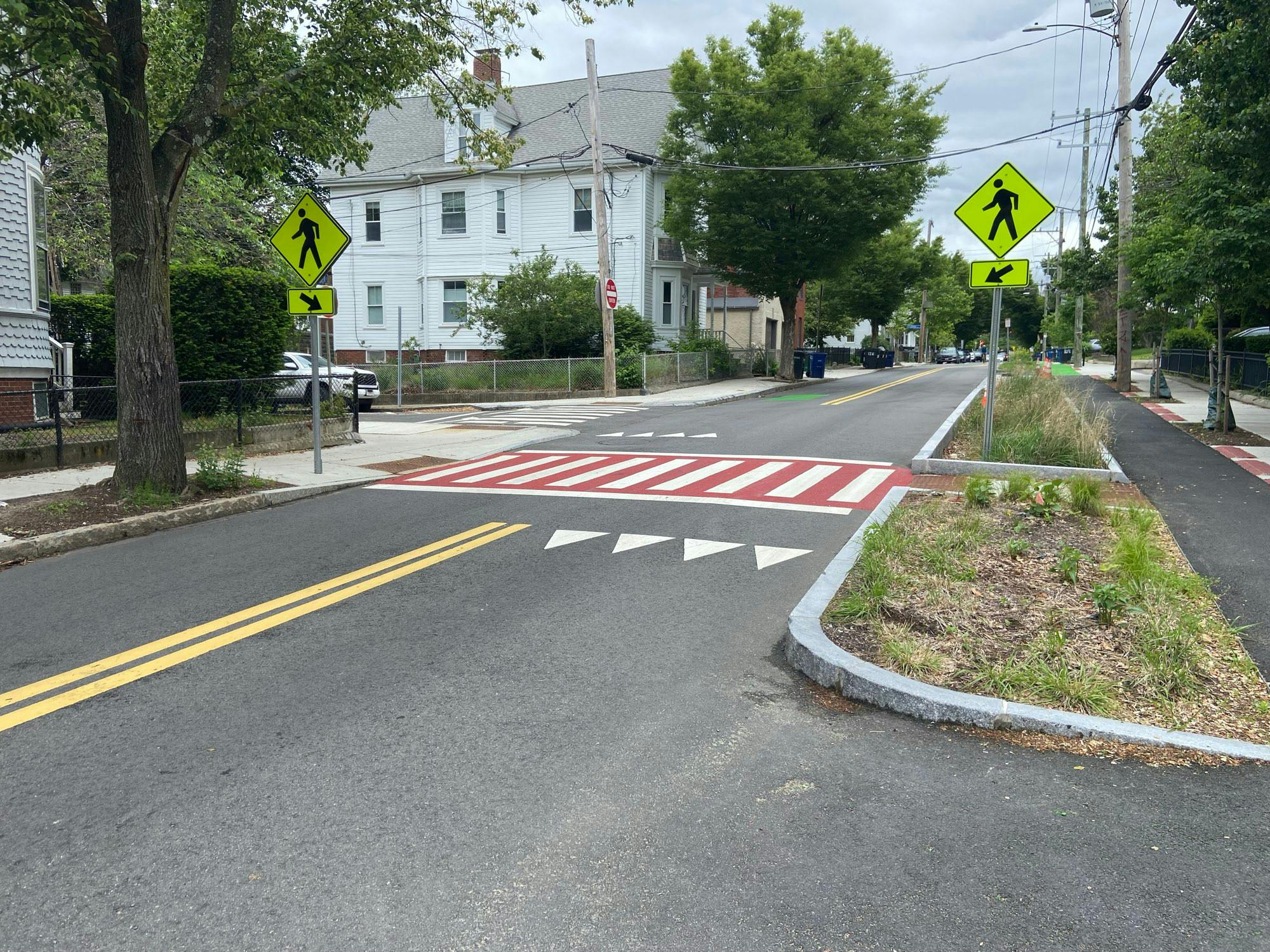
Summer Street. Photo courtesy of the City of Somerville
Somerville, located just northwest of Boston and bordering Cambridge, is steadily building one of the most complete urban bike networks in the country. With a City Ratings score of 63 — compared to Cambridge’s 68 and Boston’s 35 — the city is closing the gap through strong policy commitments, strategic infrastructure investments, and careful coordination with utility and public works projects.
Before its recent redesign, the city’s Summer Street saw about 8,000 cars a day, with more than half of them travelling faster than 25 miles per hour. The corridor had narrow sidewalks, minimal bike markings, and wide, hard-to-cross intersections. The city’s rebuild changed that experience entirely. Today, Summer Street features half-raised curb-protected bike lanes, raised crosswalks, mid-block speed humps, chicanes, and generous curb extensions that naturally slow traffic and make walking and biking safer.
The project also paired street improvements with a major sewer replacement, allowing the city to stretch construction dollars further. By coordinating the work, Somerville was able to add nearly 200 new trees, install stormwater gardens, and bring long-term green infrastructure benefits to the neighborhood without inflating costs.
“Reducing vehicle speeds and improving safety for all road users was our top priority,” said Brad Rawson, director of Somerville’s Mobility Division. “By coordinating with the sewer and utility work, we significantly reduced costs while reimagining the streetscape to prioritize walking, rolling, and biking,” added Senior Project Manager Dan Amelin, Nick Alakel, construction public information officer, noted, “These stormwater gardens serve a dual purpose — they calm traffic while enhancing the neighborhood’s aesthetic appeal.”
Early results are promising. Traffic volumes on Summer Street dropped by more than 30%, and speeding vehicles decreased from 55% to 19%.
Looking ahead, Somerville plans to continue implementation of its Safe Streets Ordinance, which mandates a 30-mile network of protected bike lanes by 2030, alongside pedestrian and transit upgrades.
Market Street + The Lynnway | Lynn, Massachusetts
The nearly complete Northern Strand Trail extension in Lynn. Photo courtesy of Bike to the Sea
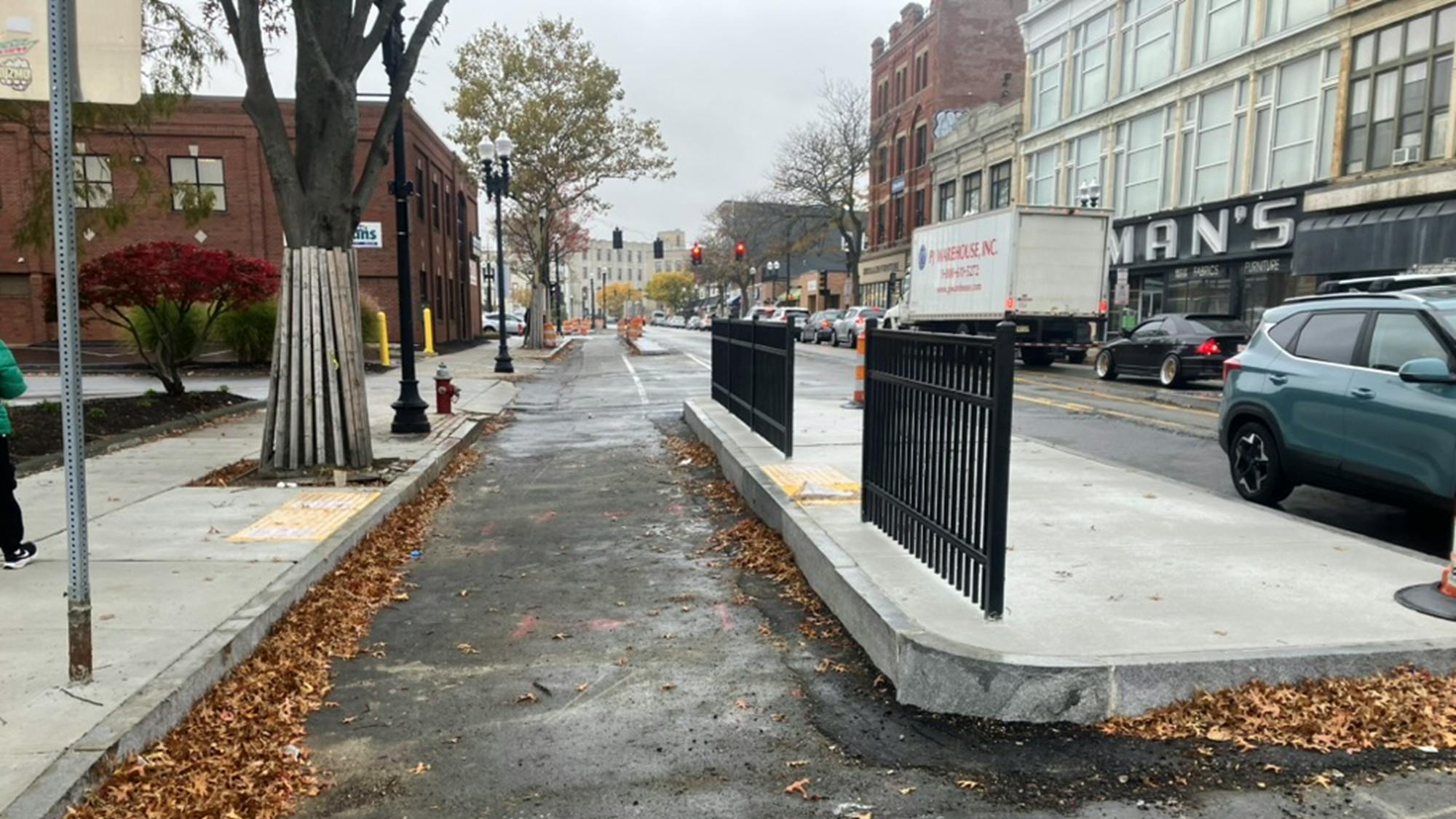
Not far from Somerville, Lynn, a coastal city of about 103,000 people north of Boston, has a new two-mile bikeway connecting downtown to Nahant Beach as part of the larger Northern Strand Trail. The project closes a long-standing gap where the trail previously ended at Western Avenue and creates a seamless connection to the regional network that stretches south through five communities and forms part of the 3,000-mile East Coast Greenway. The extension emerged from a state-led planning effort launched in 2018.
Before construction, Market Street and the Lynnway were marked by narrow sidewalks, unprotected bike lanes prone to double parking, and fast-moving traffic on a five-to-six-lane highway. The redesign replaces those conditions with curb-separated bike lanes, improved crossings, and upgraded bus stops alongside new landscaping, stormwater gardens, and branded trail signage that matches the rest of the Northern Strand Trail. These improvements make it possible for residents to reach downtown businesses, the Lynn Common, Red Rock Park, King’s Beach, and Nahant Beach without relying on a car or paying high beach parking fees. By reducing lanes along the Lynnway, the project created room for bioretention basins that replace pavement with previous surfaces and boost stormwater infiltration.
Honorable Mention: Smith Road | Tempe, Arizona
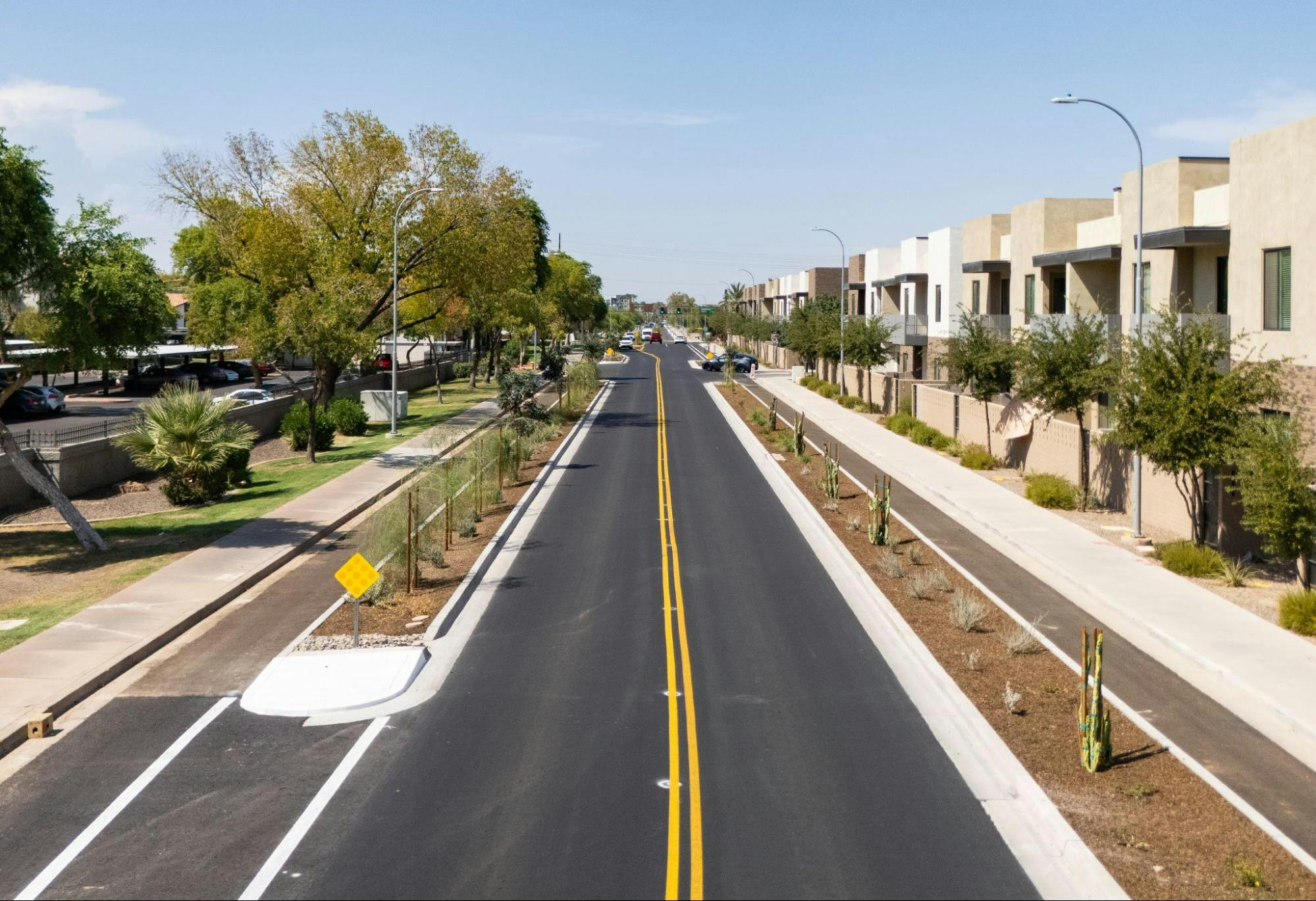
Tempe’s Smith Road improvements. Photo courtesy of the City of Tempe
In 2025, the City of Tempe completed improvements along Smith Road between Apache Boulevard and Rio Salado Parkway, creating a safer, greener, and more accessible corridor for people biking, walking, and using transit. The project added protected bike lanes, upgraded sidewalks, ADA ramps, new bus shelters, and lighting. The corridor links Culdesac Tempe — the country’s first car-free neighborhood — with Tempe Marketplace, the Alegre and Escalante neighborhoods, and the Rio Salado Path System.
“It was important to create a streetscape that worked for both residents and nearby businesses,” said Sue Taafe, transportation and sustainability administrative supervisor. Culdesac funded a new signalized light rail crossing to improve access between the neighborhood and the wider transit network. Green infrastructure features manage stormwater, reduce the heat island effect, and strengthen the urban canopy. “It’s a micromobility-friendly corridor that supports walking, biking, and transit use in a way that’s comfortable year-round,” Taafe added.
____________________________________________________________________________________
2025’s featured projects highlight what’s possible when communities treat streets as true public spaces. From Seattle’s waterfront to Somerville’s neighborhood corridors, these projects blend safety, connectivity, and climate-ready design, making it easier for people to get around while creating healthier, more resilient communities.
If you’d like to support similar planned projects in your community, check out PeopleForBikes’ Nationwide Bike Project Tracker.
Related Locations:

Take Action

Donate Now
Bring Better Biking to Your Community