

The U.S. E-Bike Market Is Bigger Than the Numbers Show
By: José Maldonado, Chief Marketing Officer

PeopleForBikes data shows the U.S. e-bike market isn't shrinking, it's changing shape, from recreation toward everyday transportation.
For two years, the headline story about the U.S. e-bike market has been contraction: inventory gluts, discounting, and consolidation among hundreds of brands, set against a bicycle market worth about $6.6 billion in 2024, down 8% year over year, according to PeopleForBikes data developed with Circana. All of that is true. But it is also incomplete.
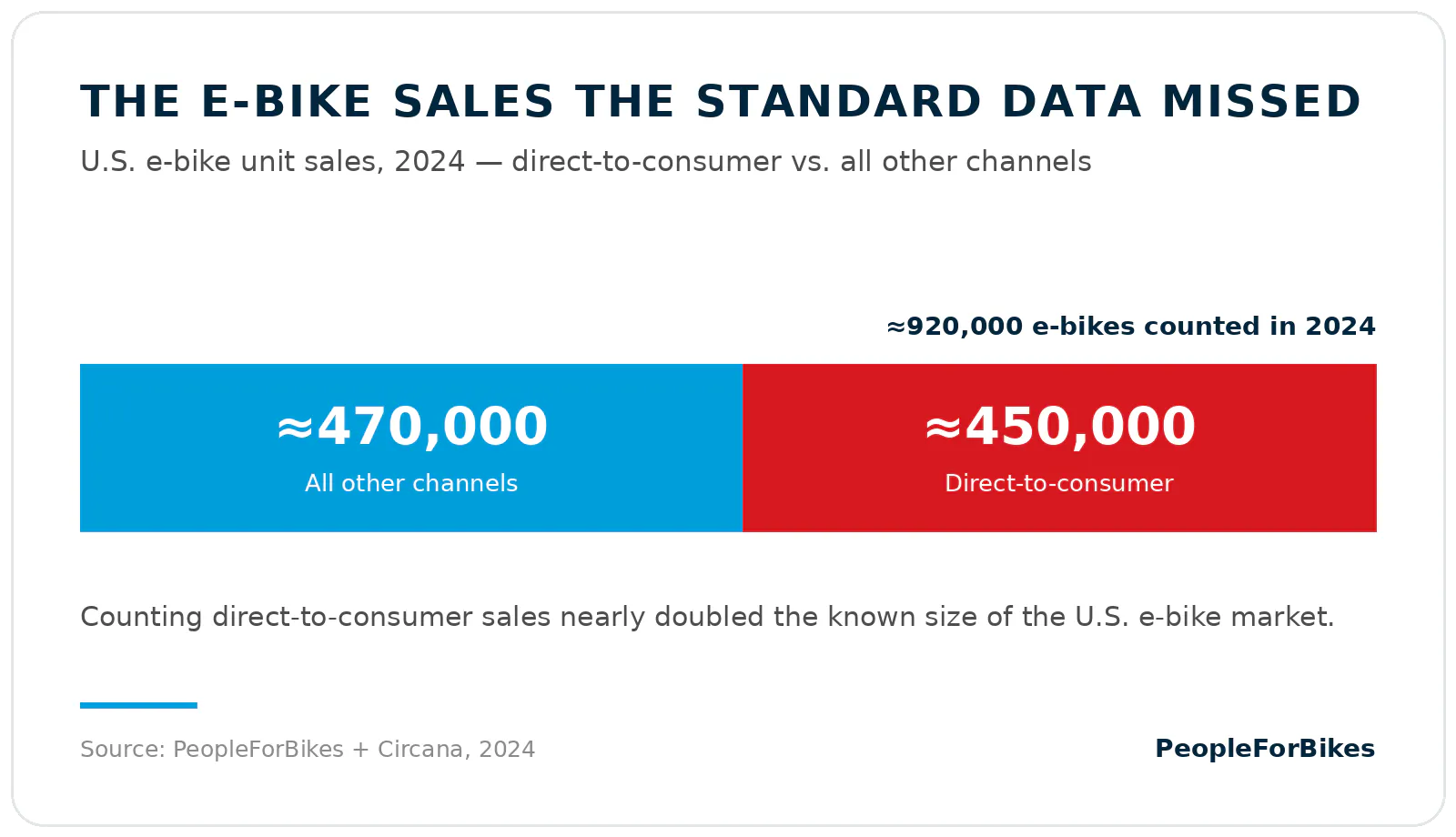
When PeopleForBikes measured direct-to-consumer e-bike sales in 2024, the bikes sold straight from brand websites, outside of the traditional retail channels most market data tracks, we counted roughly 450,000 units worth about $800 million that the conventional numbers had missed. That single finding effectively doubled the known size of the U.S. e-bike market. For years, a large and fast-growing share of the market was invisible. Add to that another 80,000 e-bikes sold on peer-to-peer marketplaces, and nearly 1,000,000 e-bikes were bought or sold in 2024.
Read alongside the rest of our data, three signals describe a market shifting from recreation toward mobility and from enthusiast toward everyday rider.
The Buyer Has Changed
The most durable demand is for bikes that work as transportation. In Upway's resale data, commuter-oriented models accounted for 54% of sales. By our data, the electric cargo category, estimated at about $100 million in U.S. sales on roughly 38,500 units in 2024, is among the fastest-growing in the market. presenting At the 2026 National Bicycle Dealers Association Summit, Upway’s Alessandro Pregel reported that its strongest longtail cargo models often sell within a day of listing. This pattern highlights how many riders treat a bike the way they treat a car or a transit pass — a tool for getting somewhere, with someone, carrying something.
That realization widens the market well beyond the enthusiast rider. Our largest growth opportunity is not the rider we already have, it is the family, the commuter, and the errand-runner who have never called themselves a “cyclist.”
What Buyer Behavior Signals for the Classification Debate
As e-bike classification debates are underway in statehouses and city councils across the country, one data point is critical to point out: of the direct-to-consumer e-bike sales PeopleForBikes measured in 2024, 98% were throttle-equipped. Upway's resale data points the same way, with buyers favoring throttles and faster Class 3 or hybrid Class 2/3 bikes that throttle up to 20 mph but allow pedal-assist up to 28mph.
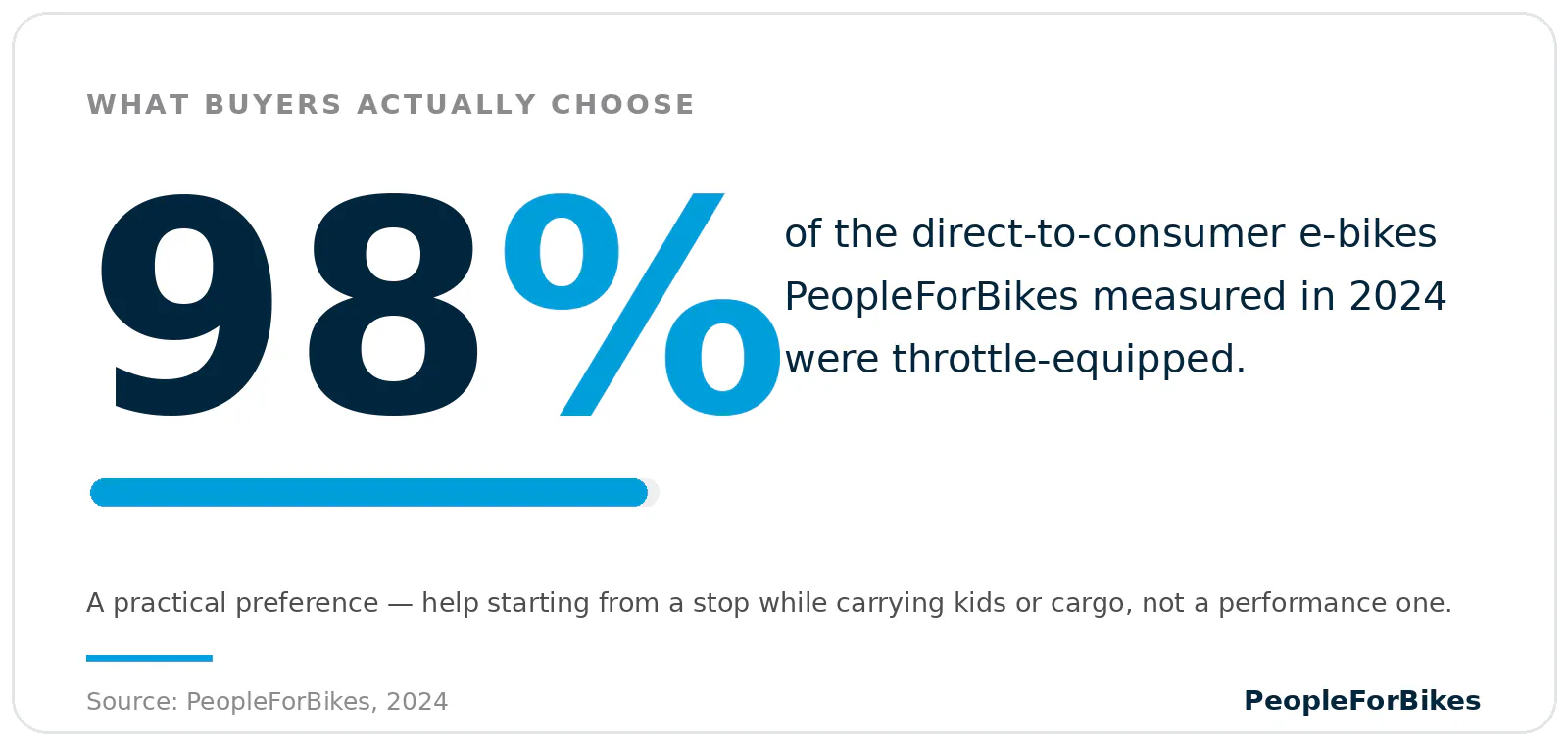
The simple read is riders have a taste for performance. The likelier explanation is it’s a practical choice. Riders carrying a child’s seat or a week of groceries value the extra help getting started from a stop, climbing a hill, or merging into traffic. As classifications and throttle rules are debated, often in the abstract, this data describes how people actually ride.'
The Secondary Market is Lowering the Cost of Entry
The third signal is the easiest to overlook but may matter most for growing participation. A used e-bike market is emerging, and it is healthy. By our data, e-bikes on the used market carried the lowest stock-to-sale ratio of any bicycle category in 2024. Listings sell nearly as fast as they appear and used e-bike unit sales are growing faster than used traditional bikes. Upway reported that it now sources roughly two-thirds of its inventory directly from consumers rather than dealers, and that residual values, after falling from pandemic peaks, stabilized and began to recover in 2025.
Affordability is consistently the largest barrier to e-bike adoption. A working resale market lowers the entry price, creates trade-in pathways that make new purchases easier to justify, and reaches first-time riders who would not buy new. Every used e-bike that changes hands is another rider the industry reaches at a lower price point.
We Are Still Early
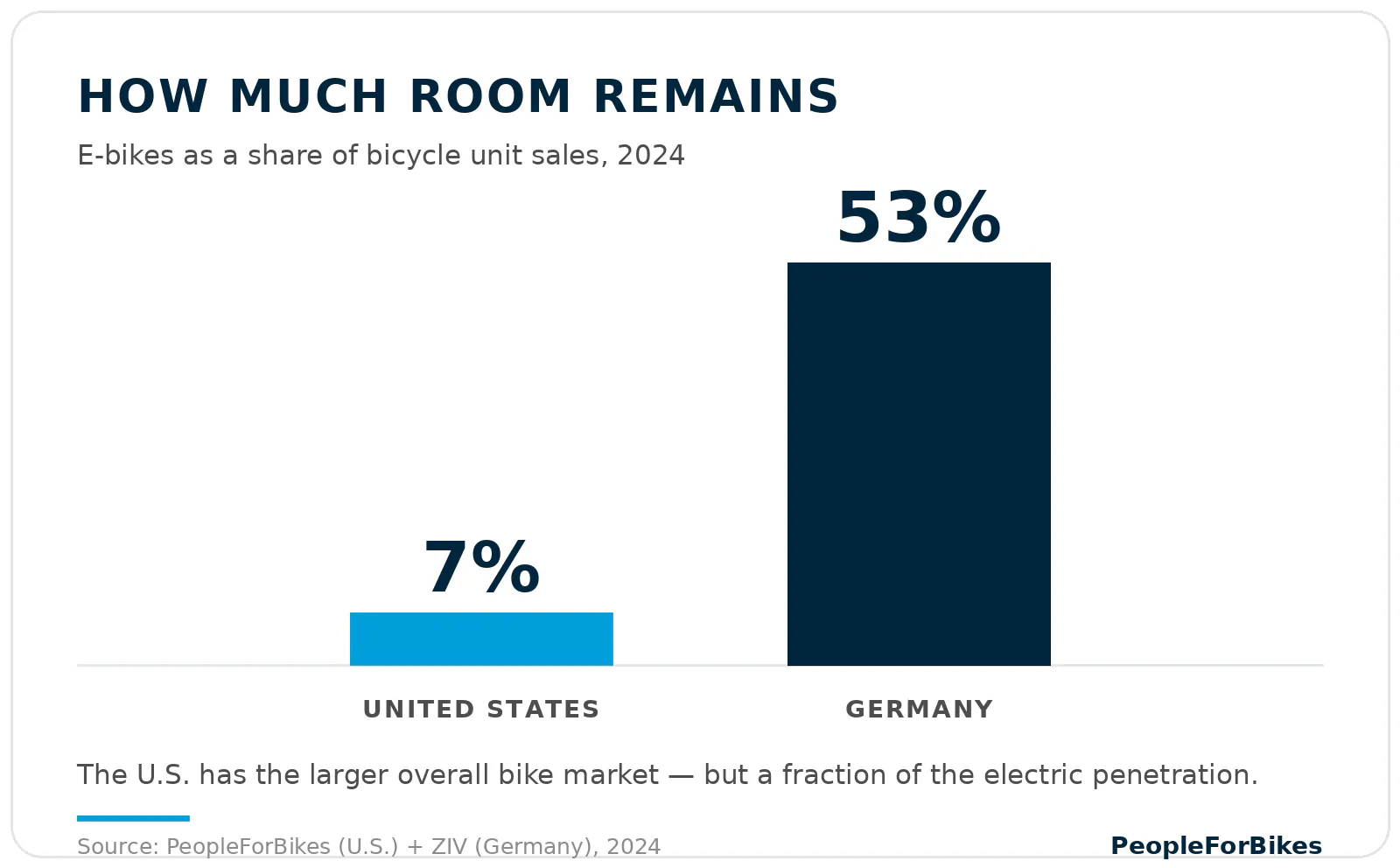
For all the talk of a maturing market, the U.S. is far from its ceiling. Germany, one of the world's most developed e-bike markets, sold about 3.85 million total bikes in 2024, of which roughly 2.05 million were electric, according to the German bicycle industry association ZIV. By unit volume, e-bikes accounted for about 7% of U.S. bicycle sales in 2024, compared to 53% in Germany. The U.S. has the larger overall bike market but a fraction of the electric adoption, a measure of how much room for growth still remains.
The Bottom Line
E-bikes are normalizing into American transportation. The buyer is changing, purchase behavior is signaling intent to regulators, a resale market is widening access, and the gap to mature markets is wide. None of those conclusions are visible from the headline retail numbers alone.
An industry that plans on partial data plans badly: it misreads its customers, miscalibrates its advocacy, and undervalues the channels and categories carrying its growth. PeopleForBikes invests in market intelligence, including the PeopleForBikes Data Suite (powered by the Bicycle Industry Data Exchange), because the full picture changes the decisions. These numbers came from measuring channels that the standard data misses.
The market most people read says the industry is contracting. The market our data describes is getting bigger, broader, and more central to how Americans get around. We intend to keep counting all of it, because the goal was never just a bigger market — it’s more people on bikes.
PeopleForBikes market data is developed with Circana and through proprietary direct-to-consumer research, and is available to members through the Business Intelligence Hub. Additional context draws on transaction data presented by Upway.

Take Action

Donate Now
Bring Better Biking to Your Community