

Building Better Communities: Blue Crane’s Bike-Forward Vision for Northwest Arkansas
By: Kimberly Huntress Inskeep, contributing writer
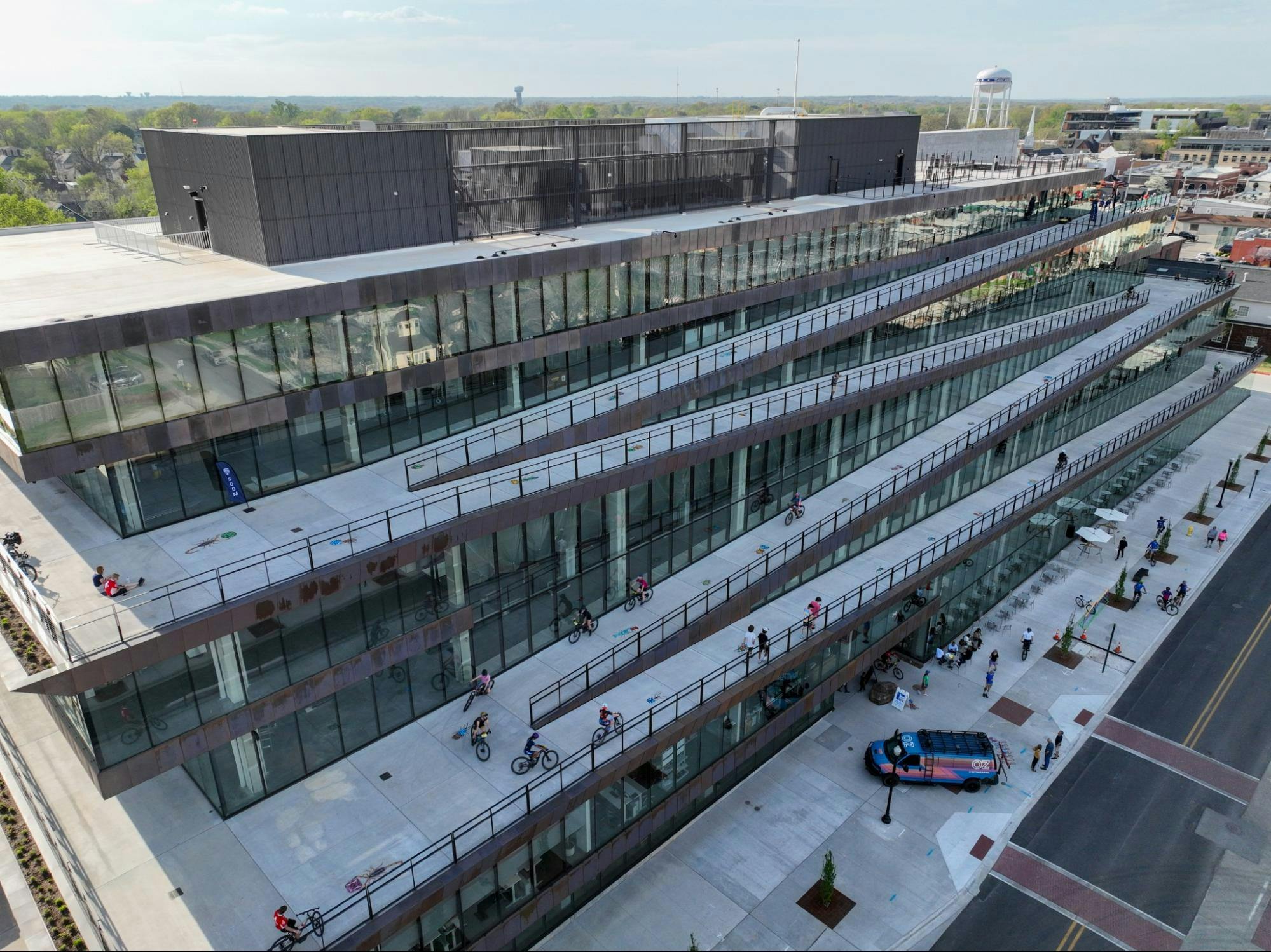
Blue Crane is reshaping Northwest Arkansas to meet a growing population’s appetite for bike-centered, active living and cosmopolitan amenities while holding strong to its hometown feel and sense of identity.
Bicyclists enjoying the switchback at Ledger — the world’s first bikeable office building. (Photo courtesy: Blue Crane)
Welcome to PeopleForBikes’ Building Better Communities series, where we highlight the people building great communities throughout the U.S. — with bikes in mind. Meet the developers building to meet the growing demand for walkable, bikeable neighborhoods, alongside a breakdown of the approaches these visionaries have adopted and their key takeaways on how other communities and developers can build better for bikes and the people who ride them.
Almost two decades ago, Northwest Arkansas (NWA) leaders began forging a recreational boom out of the region’s natural elements — the foothills and heights of the Ozark Mountains. The move put NWA on the map as an international mountain biking destination. The 2015 completion of the initial 37 miles of the Razorback Regional Greenway (40 miles today) connected the communities of Bentonville, Fayetteville, Rogers, and Springdale, beckoning to every kind of cyclist.
The region’s largest employers bet on the new recreational assets to attract workforce talent, converting visitors to residents. It worked: NWA has been one of the nation’s fastest-growing regions over the last two decades; Bentonville’s population alone jumped from 38,284 in 2010 to 54,210 in 2020, a 53% increase. People weren’t just visiting NWA to ride their bikes, they were moving there to enjoy the lifestyle.
With new residents came the need for new housing and services and Bentonville-based developer Blue Crane was ready to provide it. The firm was founded by Tom and Steuart Walton, with an initial focus on developing hospitality properties in downtown Bentonville. Blue Crane was well-positioned to tap into the demand for residential and commercial projects that could serve the active lifestyles sought by new residents and has expanded its investments accordingly.
The Opportunity: Offer Active Living from Home to Work to Play
Much like NWA’s 500-mile bike trail system was designed to offer something for every type and level of rider, Blue Crane is building a diversified portfolio of projects for nearly every type of resident and business, meeting cyclists where they are and all the places they want to be.
“[Newer] residents, whether they're remote workers, entrepreneurs, or professionals relocating from other markets, have different expectations for how their daily lives integrate with outdoor recreation. They want to bike to work, to dinner, to meet friends — not just on weekends for recreation,” says Katie Parsons, spokesperson for Blue Crane. “Our aha moment came when we realized that most new development wasn't fully capitalizing on this incredible asset.”
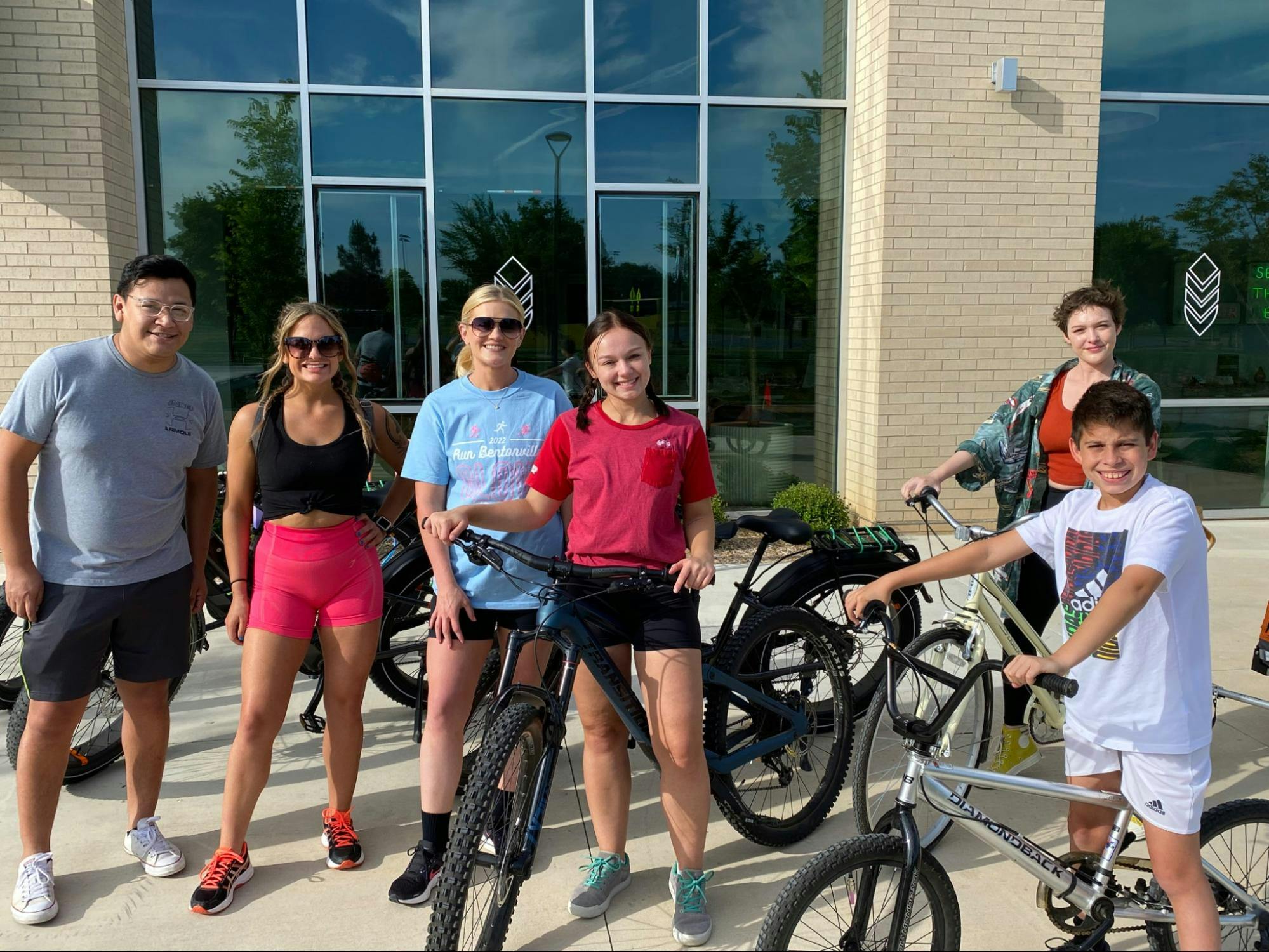
Riders take a break at Crystal Flats, a mixed-use project in downtown Bentonville. (Photo courtesy Blue Crane)
Crystal Flats is a 27-acre, 622-unit mixed-use residential project in downtown Bentonville that reflects Blue Crane’s deliberate approach to bike-friendly development and features ample biking and walking pathways through the property, its own bike washing and repair stations, connections to nearby bike trails, and an easy walk to downtown. “Residents need secure bike storage, easy trail access for commuting, and connectivity to services they use regularly,” Parsons notes. “We design with bike storage as part of our design process and strategically select sites that ensure trail connections and bikeability are functional for daily errands.”
The commercial and hospitality properties are similarly packed with bike amenities, catering to bike-focused visitors and locals alike. These properties accommodate a range of bike transportation needs, from single-day trail riders to multi-day tourists traveling with their gear by incorporating bike storage, washing stations, maintenance access, bike valet facilities, and spaces designed to welcome cyclists as well as their gear. Among the newest of the hospitality projects is The Compton. "Every element of The Compton is conceived with the adventurer in mind, mirroring the beauty of the Ozarks and catering to Bentonville's vibrant cycling scene," said Brian Shaw, development partner for Blue Crane.
Incorporating local materials and native plant species, the hotel is named for Bentonville native and conservationist Dr. Neil Compton and serves as an example of how Blue Crane’s transformative work has been thoughtful in highlighting the region’s rich history and heritage.
Sometimes, accentuating history comes with a big dash of innovation. Red Barn is an “urban agrihood” in north Bentonville, offering apartments and townhomes nestled together to maximize greenspace for a more rustic feel. The site’s eponymous red barn serves as an event space, and the property includes a farm that supports the next generation of small, local farmers, with events featuring local food and culture. Biking and walking trails criss-cross the property and connect to the region’s trail system, offering rural living with the ability to easily enjoy a car-free or car-light lifestyle with easy access to the city.
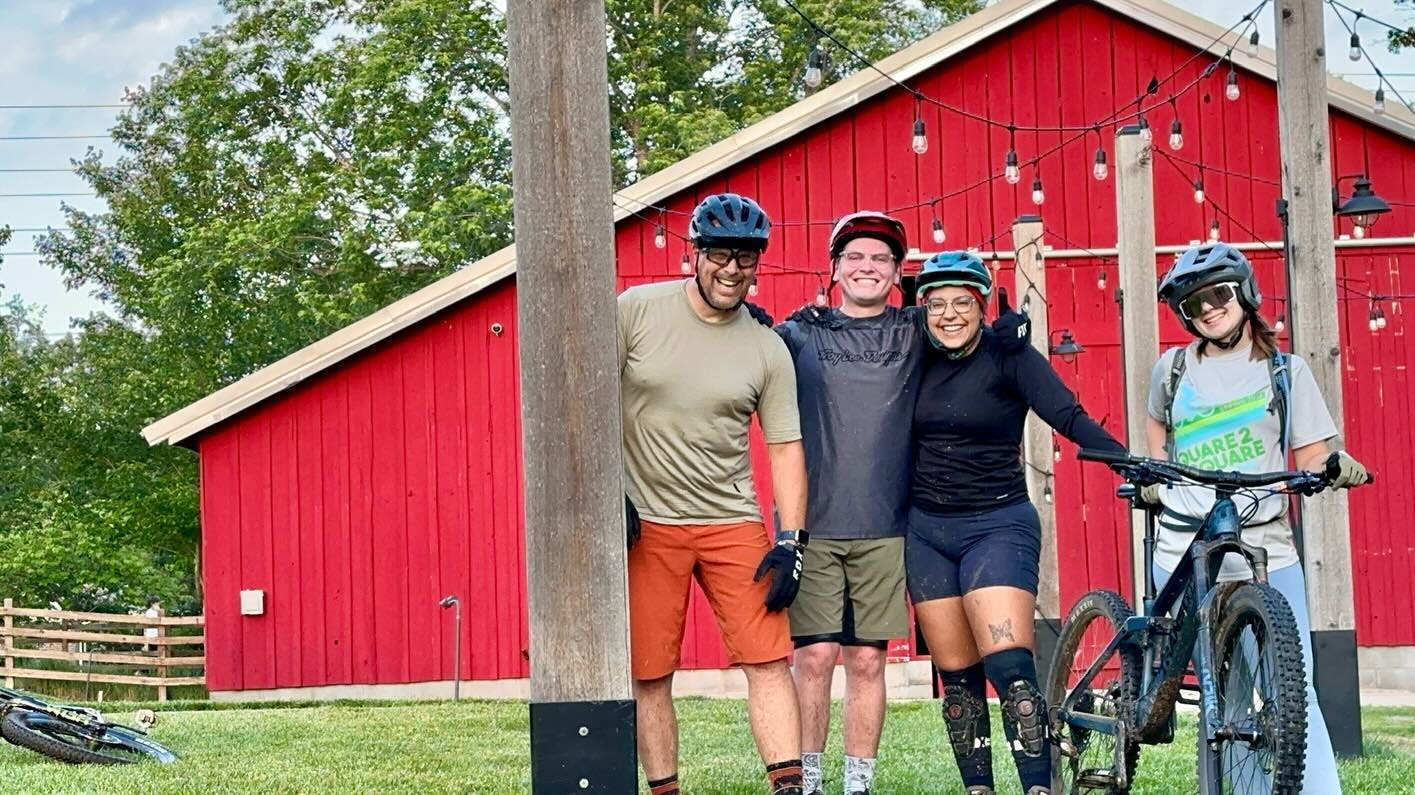
Riders at Red Barn. (Photo courtesy Blue Crane)
Other times, Blue Crane has departed from tradition with outright daring. Ledger, the world’s first bikeable office building, boasts a modernistic facade wrapped in outdoor switchbacks that climb its six floors over three-quarters of a mile. The hybrid office building/co-working space/event venue also features showers and changing rooms for bike commuters to freshen up when they arrive.
“The bike-forward approach manifests differently across our development types, but the core principle remains consistent: seamless integration with the cycling ecosystem,” says Parsons.
The Return on Investment: Compound Interest
Blue Crane’s bike-forward approach has netted direct and indirect returns that compound over time by building on and reinforcing each other.
Those immediate and near-term returns have come in several forms: properties that feature quality bike amenities “command premium pricing, [see] faster lease-up and sales cycles, particularly for demographics aligned with a cycling lifestyle, and higher tenant retention,” says Parsons. Because residents typically own fewer vehicles, the developer also benefits from lower parking infrastructure costs.
Indirect, longer-term benefits are just as impressive. “The most significant long-term benefit is positioning our developments as integral to NWA's competitive advantage in talent attraction. When companies like Walmart, J.B. Hunt, and Tyson are recruiting globally, having housing and commercial options that showcase the region's cycling culture becomes a powerful economic development tool,” Parsons notes. The result is a marketing differentiation that attracts exactly the demographic Northwest Arkansas is trying to recruit — educated, entrepreneurial, outdoor-oriented professionals.
Likewise, when properties welcome cyclists unconditionally, those places become destinations in their own right, boosting retail sales. The extensive availability of bike-friendly properties makes it easy for cycling organizations and event producers to choose the region and partner with local firms, which in turn creates marketing opportunities for Blue Crane and property managers.
Blue Crane has at least six new projects in the pipeline, including more hotels and two mixed-use properties in Bentonville and Springdale.
“[There’s a] growing demographic that sees cycling connectivity as essential infrastructure, not just an amenity,” Parsons says. “This market values walkability, trail access, and reduced car dependency as much as traditional amenities.”
Lessons for Developers and Local Governments
While few regions have gone as all-in on cycling as NWA, there are plenty of lessons Blue Crane has to offer other communities for capitalizing on bike-forward development. Here are their tips.
For Developers:
Connectivity Comes First
Bike racks and trail connections are essential, but proximity to these assets alone doesn’t automatically equal bike friendliness. “Study actual cycling patterns and design for seamless integration with existing infrastructure. Map the routes your residents or visitors will actually take,” Parsons recommends. Development approvals often proceed more smoothly when projects clearly connect to supporting regional economic development goals.
Design for All
Ensure your design recognizes the different storage, security, and access needs of every kind of cyclist: commuters, recreational riders, visitors, families, and serious enthusiasts.
Make Cycling Foundational, Not an Extra
Start from the ground up by ensuring bike infrastructure is fully considered in site planning, architectural design, and landscaping from concept to market. “Retrofitting is expensive and rarely achieves the same level of integration,” Parsons notes.
For Local Governments:
Update Parking Requirements
Reduce minimum parking requirements for developments with strong bike infrastructure to reduce the time and cost of building. “Current standards were written for car-dependent developments,“ says Parsons.
Streamline and Clarify Processes
Create clear processes for developers to connect to existing trail systems. Currently, this often requires navigating multiple agencies and unclear standards, which can eat into time and budgets.
Incentivize Cycling Infrastructure
To encourage developers to exceed basic bike standards, offer incentives such as reduced fees, expedited permitting, and density bonuses.
Related Locations:

Take Action

Donate Now
Bring Better Biking to Your Community