

What Gets Mapped Gets Measured: Updating OpenStreetMap to Improve the Accuracy of Your City Ratings Score
By: Grace Stonecipher, Infrastructure Analytics and Research Manager
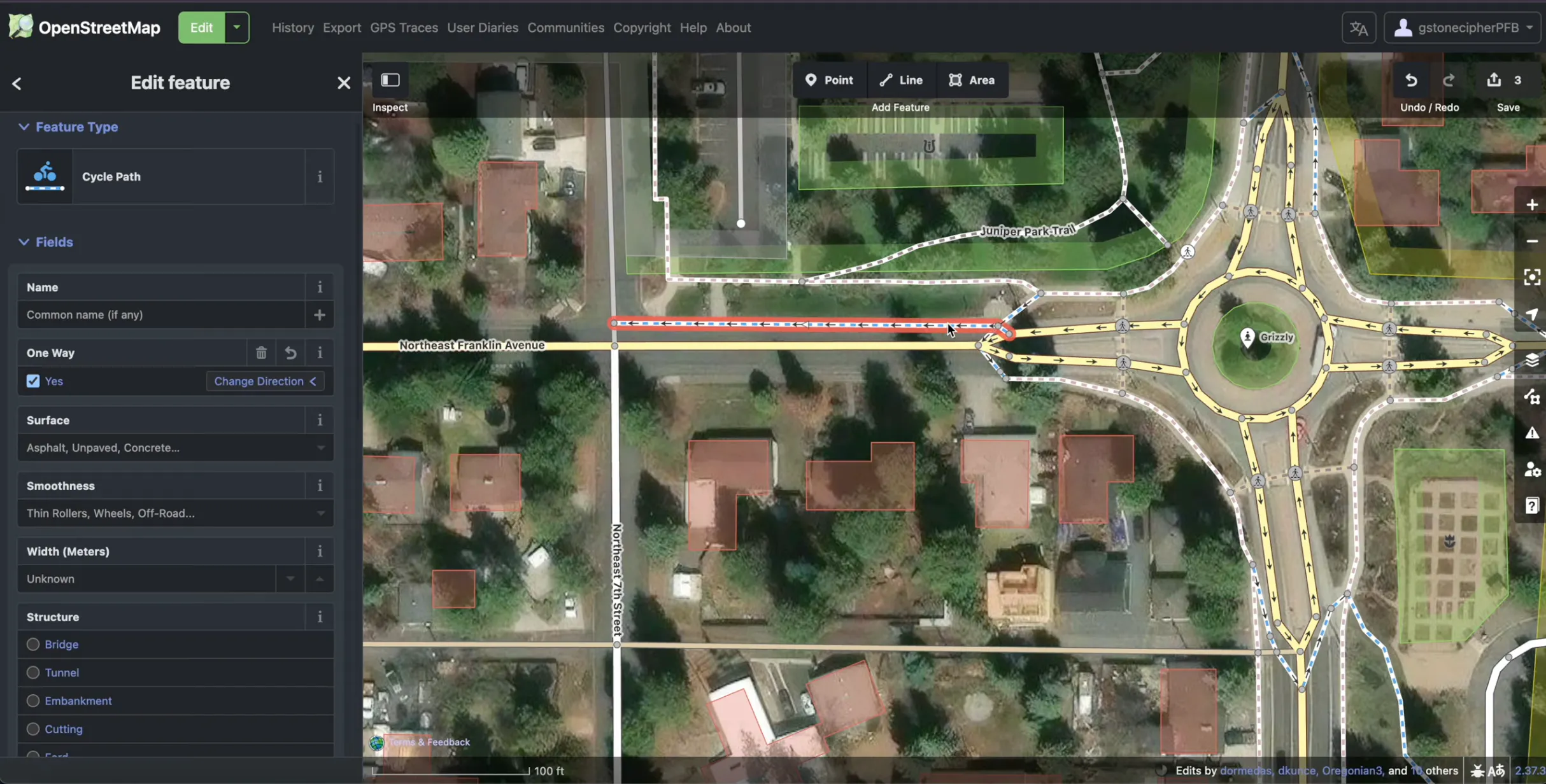
If your city’s bike infrastructure isn’t fully reflected in PeopleForBikes’ annual City Ratings, you can fix that using guidance from our recent mapathons.
Trusted, accurate data is a key pillar of PeopleForBikes’ annual City Ratings. With thousands of cities analyzed each year, City Ratings relies on local advocates and planners to keep their city’s bicycle infrastructure data up to date in OpenStreetMap (OSM).
City Ratings are calculated using the Bicycle Network Analysis (BNA), which pulls the latest data from OSM and factors in features like new bike lanes, updated speed limits, and relevant destinations in each city. By ensuring that OSM reflects all of the changes implemented within the last year, cities can improve the accuracy of their ratings.
In February, PeopleForBikes hosted two mapathons, bringing together stakeholders to learn about different tools for updating OSM. The goal of these sessions was to increase comfort with the editing process and go over the features and tags most relevant to the BNA and City Ratings. In preparation for these sessions, PeopleForBikes put together an instructional packet, as well as multiple video tutorials:
Mapathon Packet: Mapping Bicycle Data in OpenStreetMap
Video Tutorial: Updating tags using iD
Video Tutorial: Adding new features using iD
Video Tutorial: Editing and adding features in JOSM
Video Tutorial: Loading external data sources into JOSM
Sixty participants from across the U.S. and Canada joined the mapathons, spanning a wide range of OSM editing experience. The first mapathon focused on editing with iD, a browser-based, beginner-friendly editor that allows users to add new features and update existing ones. The second mapathon was designed for participants who were already comfortable working with spatial data, exploring how the JOSM desktop editor can be used to streamline and scale OSM editing.
Both workshops started with an overview of the different types of bike infrastructure considered in the BNA and their associated tagging schemas in OSM. A key takeaway was that there are often multiple approaches to mapping bike infrastructure, and exploring how similar features have been mapped around a city can provide a helpful guide. Participants were then given the opportunity to see the editors in action though live demos. The iD editor was used to add in a recently completed protected bike lane and a new doctor’s office destination. In JOSM, participants were shown how to load in their own spatial data to systematically check infrastructure, and how to use filters and selection tools to update the speed limits of multiple features at once.
The mapathons ended with open mapping time, where participants worked on adding features into OSM from their own cities. Everyone was encouraged to ask questions and share their screens as issues arose, providing opportunities to learn from one another and build a sense of community around the editing process.
Most participants were able to make at least one edit to their city’s map and reported feeling more confident in their ability to make future edits. PeopleForBikes plans to host more mapathons later in the year with a focus on mapping recreational bicycle infrastructure in addition to updating features for the BNA and City Ratings.
How You Can Start Mapping Today
You don’t need to be a GIS expert to contribute to OpenStreetMap. Here’s how to get started:
1. Create an OpenStreetMap account. Sign up for free and explore your city’s existing data.
2. Start with the iD editor. If you want to improve your community’s City Rating, prioritize mapping:
- Protected bike lanes and side paths
- Off-street trails and greenways
- Updated speed limits
- Key destinations (schools, grocery stores, transit stops, healthcare)
3. Follow existing mapping patterns. Look at how similar facilities are tagged nearby and match that approach.
4. Make your first edit (even a small one). Simply adding one missing bike lane improves your city’s data.
Ready to start mapping? Use the resources below to make your first edit today and help ensure your city’s bike network is fully represented.
Mapathon Packet
Mapping Bicycle Data in OpenStreetMap
FAQ
Editing in OpenStreetMap: Frequently Asked Questions
Video Tutorials
Video Tutorial: Updating tags using iD
Video Tutorial: Adding new features using iD
Video Tutorial: Editing and adding features in JOSM
Video Tutorial: Loading external data sources into JOSM
Mapathon Recordings

Take Action

Donate Now
Bring Better Biking to Your Community